
Tag Archive for: German classes

8 German compound words that have a surprising meaning whether you speak German or not

Compound words? They are a classic of the German language. These however have a very unpredictable meaning

When learning German, one of the most common obstacles encountered by students lies in the difficulty of memorizing a very large lexicon of which one often struggles to remember the meaning, especially due to the difficulty in recognizing the root of the word. One advantage of German is, however, the tendency to make extensive use of compound nouns and verbs. Learning the meaning of suffixes and prefixes is therefore very useful to construct the meaning of a compound verb of which we know the primary meaning. During this meticulous process of destruction and composition of the language (evidenced by the German correspondent Wortzusammensetzung), which is becoming more and more pleasing to those who wish to know German and master it better, it is also possible that German will make us smile, giving us words that have an unusual meaning longing to a remote past.

Here are just a few German words that have an unexpected meaning.

Klobrille

When you first arrive in Germany and hear speaking of “toilette glasses” it might be quite disorientating. After asking to repeat the question we discover that, yet, klobrille is actually a word, and it is simply the toilet seat!

Brustwarze

This word is composed by two terms, wart and breast, that blended together might create a not so pleasant image. In reality it does not refer to strange anatomical blemishes, but to a part of the body that Germans, perhaps for the analogy of the form, call warts: nipples! When you will find yourself talking about nipples in German, be sure that this part of the body will have lost all of its charm.

There is no need to change zone then to find out that the most intriguing female garment, the bra, in German has a name similar to that of a posture corrector tutor, Büstenhalter, “breast-sustainer”.

Eselsbrücke

If you think that this term, which literally means “donkey bridge” is a German invention to further confuse non-native speakers, you are mistaken. Nowadays the term is used in German to indicate a method, a word or phrase that allows you to remember something better. The question is: what do donkeys have to do with this?

The answer is sought in the past and in the latin location of pons asinorum, used in philosophy to indicate figures that allow less experienced subjects to understand a more complex concept, and in mathematics it is used in reference to the difficulty of understanding the fifth Euclide theorem on the isosceles triangle. It has thus an ambivalent meaning, on the one hand, of a device that facilitates understanding for the less learned, on the other, it indicates a “dormant” donkey backbone difficult to overcome.

Durchfall

Even if this term might seem hard to grasp, the English correspondent diarrhoea presents a morfology deriving from the Greek δια+ρρέω (dia+rrheo) “to scroll through”. If you unpack the German word, the Greek influence becomes apparent.

Donnerstag

Thursday in German is the day of thunder. Translated in English, the German correspondent Donners-tag would be Thunder-day, an analogy that shows the link amid these two languages. After all also in Italian (Giovedì), French (Jeudi) and Spanish (Jueves), the reference to Jupiter becomes clear. The fourth day of the week is thus dedicated to more than one nation to the god of thunder!

Mutterkuchen

When they talk about “mom’s cake” Germans don’t refer to a dessert to have for breakfast but to something very different. Mutterkuchen means placenta, but also this compound word doesn’t come out of nothing. The term placenta derives from Greek πλακοῦς (plakous), an adjective that indicates something with “crushed form”. The adjective then passed through latin with the meaning of flatbread. Why call flatbread this vascular organ? Because the placenta has a crushed form and through it the fetus can be fed, just like a flatbread.

Fernseher

To understand why in German television is referred to with a term that literally means “distant observer”, it is enough to trace the etymology of the word. The prefix comes from Greek and means “far away”, so it indicates a vision from afar, just like that of images projected from the screen of a TV. In German, the correspondent of ‘tele’ is fern.

Flusspferd

Even for this last example, before we put our hands between the hair of despair and blaming Germans for being incomprehensible, we should think of the origin of the corresponding term in English. Flusspferd, literally “river horse”, in English means hippopotamus. This term from a somewhat funny sound comes from Greek where hippos means horse and potamos river, so the German language copied the same structure of the word, using the terms of its own idiom.  

In conclusion, to have some explanation about some creative composite words, we should ask the direct people concerned, that is, our ancestors who created them!

—————————-

Is German stating to intrigue you? Then take a look at the German courses that Berlino Schule organizes!
10 unequivocal signs that German, for you, will always remain a mystery

Deutsche Sprache schwere Sprache, goes the saying. You might have known it prior to embarking on learning the language. But you love challenges, and you didn’t get discouraged: “How hard can it be? Six months, maximum one year of hard work and German will have no more secrets for me”. You enrolled in countless courses, you’ve climbed across levels, bought books and newspapers, listened with devotion the Deutsche Welle, harrased all sort of Tandempartners and passersby just to get a chance to practice your pronunciation.

But to your great astonishment, a few years have passed since you moved to Germany and you still struggle with a German that, although acceptable, can’t be defined as fluent and impeccable. You then start to feel a bit silly, asking yourself whether in your brain there is a specific zone whose task is to annul your efforts and delete all those notions that you constantly try to repeat by heart. But don’t worry, you’re not alone. We have identified 10 unequivocal signs that prove that German will remain to many a half mystery to many of us. In the name of reason we could say that no one has ever died out of not being a perfect mother tongue; likewise it can’t be used as an excuse: constancy, method and good teachers make more than satisfactory results even to the most refractory of minds to this impatient idiom.

Der, die or das?

It is one of the first things that you learn in school and, after all, learning the declination is not that hard. The real tough part is learning how to use the masculine, feminine and neutral: it’s true, there are some rules that allow us to understand the gender of a noun, but there are also several exceptions. Moreover, have you seen how many terms German has? Confronted with these challenges there are only 3 possible solutions: a) Renounce completely the article (several Berlin immigrants have opted for this option and have lived happily for decades), b) try to guess, c) mumble and try to trick your interlocutor. Neither option is one to be proud of…


Photo © Youtube

To decline correctly the adjective: maybe in another life?

The adjective, in German, is declined concurring to the gender, number and case. As if it wasn’t enough, there are three different forms of declinations according to the term that precedes it (determinative or indeterminative article or absence of the term). Such a combination requires for an indepth memory study. But the real challenge is when it comes to talking: you have to be able to coordinate article, adjective and noun, and prior to that, determine the gender of the noun, the operation upon which the whole mission depends on. The whole as trying to structure the whole architecture of the sentence. Headache? Kein Problem, the three suggested solutions before remain valid…

Photo © Deutschlernerblog.de

The verb at the end of the subordinates.

In German the infinite and the past participle go to the end in the main sentences, while in the subordinates there is also the verb to the indefinite form. The situation is even more appealing when, in Nebensatz, there is a modal verb and an infinite or, worse, a modal verb with the consequent, infamous rule of double infinity. Here too, with a lot of application, you can study the rule and apply it correctly when writing (quickly: let’s say in a fifteen to twenty minutes). Okay, but when are you in the middle of a speech? You let your beloved, old syntactic English structure take control and think “Who cares, I’ll sound weird but they’ll understand me the same”.

Photo © slideshare.net

The preposition lottery.

Place, time, cause, medium, purpose, adversity: German prepositions are infinite, can hold one or more cases and can express a myriad of different nuances. And, as if it weren’t enough, present countless exceptions. You know auf? Literally, it would mean “up”, when there is no contact with the underlyining surface (otherwise you would use über, clearly). An, on the other hand indicates proximity: “Sara ist an Fenster”, Sarah is at the window. Then again, to say “I’m at the postoffice”, why is it “ich bin auf der Post”? It is better not to question further.

Photo © memegen

Movies and songs in German.

At school they told you that looking at movies and series, alongside listening to songs is a great exercise. If possible, it would be even better without subtitles, this way you can train your ear. All true. However, most of the times, in class they propose you classics of German rock and pop, from Rammstein to the Ärzte (which are indeed more approachable also for students at an intermediate level), all the way to Bushido, one of Germany’s most notorious rappers. Heavy metal, punk, rap: but a good song-writer that pronounces everything clearly without screaming, without dialects and without guitars covering everything, is just not thinkable? We admit it with no problem: during these hearings we all cheated with subtitles every time we could.


rapper Bushido © YouTube

Wie bitte?

Staying on the topic of oral understanding: you exercise as much as you can with radio, CDs from your manual, TV series, newscasts. But when on the bus they ask you simply to pass through, or in a cafè they ask you if you want another lemon and ginger juice, you panic and you always find yourself asking your interlocutor: “Wie bitte?” asking to repeat the sentence not one, not twice, but as much as three times in a row. If you haven’t formed a wax cap, the only plausible explanation is that your auditory device is not calibrated to tune in the teutonic frequency.


Photo © memegen.de

Job interviews.

Blessed those times you despaired to prepare a university exam, which in retrospect weren’t that hard, and more importantly in your mother tongue. Now you find yourself facing an hypercompetitive market, you are facing an exigent recruiter and you have to invent a narration that is capable of selling of your capabilities. All of this in German. In the end you get out of the job interview completely exhausted, you aren’t sure about what you said and neither if you have good chances of being selected, but at least you can proudly say that you got out of it alive.

Photo © Karrierebibel

The bureaucracy.

Anmeldung, Krankenkasse, taxes, insurances to implode a 20mq flat: German bureaucracy is meticulous and relentless, the technical lexicon is as sympathetic as mononucleosis, the employees (not always: some, by experience, are nice and available) frustrated by years of kafkian grey. Days of farsighted preparation for the bureau meeting might not save you from the term that you had forgot or misunderstood, making the wake up alarm of 6am that you had to go through on that morning completely useless.


Photo © euklidnetwork

The slang.

The so-called Umgangssprache is the spoken language, the slang, the one you almost never learn in school and on books. When you start to familiarizing with it you feel cool and wish you could use it everywhere, calling Kumpel even the President of the Federal Republic and using Redewendungen and Sprichwörter in any context. However the slang is broad and tied to the local dialects. So there will always be an expression you never heard of before, that you will misunderstand within a conversation and cause for a moment of embarrassment. It will happen, it’s mathematic.

Photo © deutschlernenblog.de

The calling nightmare.

Simple operations as ordering a burger at home and reserving a table in a pizza restaurant may reveal to be intensively complicated if there isn’t the chance to read lips to understand what one is trying to say. So even here, even though you have meticulously prepared the phone call, the first unexpected response from the other head of the handset, pronounced at supersonic speed, will force you to propose a “Ja, natürlich” even though you have no idea what he or she it is talking about. In a matter of a second you’ll find your sandwich the much detested coriander.

Photo © YouTube
Cover photo © Study in De

——————————-

Wish to perfect you German in a vibrant environment? Or is German starting to intrigue you? Then take a look at the German courses that Berlino Schule organizes in the heart of Berlin! 

10 beautiful and memorable German words

Learning German is a life exercise because it is an idiom that tests us on a daily basis. Even Mark Twain, the american writer known for his troubled relation with German, a language that he didn’t particularly love but found very stimulating, said: “on the basis of my philology studies I came to the conclusion that a person prone to languages will be able to learn English (excluding the grammar and pronunciation) in 30 hours, French in 30 days and German in 30 years. It is obvious that the German language needs to be remodelled and repaired. If it were to remain as it is, it should be shelved, with gentleness and reverence, amid the dead languages, because only the dead have enough time to learn it”.

As follows we would like to propose 10 beautiful German words that have a very special meaning and that are unique in their own way to the German culture. Each of these words not only will help you expand your vocabulary, but will deepen your knowledge of this new world.

1. Sehnsucht

Amid different definitions, which vary from yearning, desire and/or craving, Sehnsucht is a feeling of longing for something unknown and indefinite. Who studied or is studying literature and in particular German Romanticism will surely have encountered this word whose roots reside in high German, meaning “illness of the painful whim”.

2. Weltschmerz

Translated as the “pain of the world” or “world-weariness”, Weltschmerz is the feeling of deep insatisfaction and pain which derives from the realization that the physical world can’t fully comfort the desires of the mind. The term was firstly coined by German Romantic author Jean Paul.

3. Torschlusspanik

The literal meaning would be the panic deriving from a closed door, but in everyday language it describes the anxiety felt when being close to a deadline. In English in fact Torschulsspanik could be translated as “last minute panic”, or the awareness that time passes by inexorably and that one has to act quickly. The door closing conveys a missed decision or action that we then might regret.

4. Fernweh

How to translate this word? Dictionaries talk about “having itchy feet” or a “wanderlust desire”, however the similar Heimach talks about homesickness and nostalgia. The root of the word in fact indicates a sense of nostalgia projected not towards our home, but towards a different place, whether known or not. Fernweh is about the longing feeling to pack a bag and depart to the discovery of a place to always bring in our heart.

5. Zweisamkeit

When we talk of solitude in English we think about a person that is alone, isolated from others. In German it’s not really the same thing. Robert Musil, in the novel “The confusions of Young Törless” when talking about life in a couple says “being in two is no more than doubled solitude”. Even spending time with our loved one, isolated from the world, mens living in solitude, however the two elements of Zweisamkeit don’t complain, because they feel perfectly complete.

6. Backpfeifengesicht

The meaning of this word is far more familiar than what you might think. Do you know those kind of people whose face is enough to make you want to slap them? Well, from today you could also call them with the German word, instead of “punching-bag face”.

7. Feierabend

If you have just arrived in Germany and recently found a job, you will often hear your colleagues say “ich mache Feierabend” and ask yourself why and how every night they are going out to party (without inviting you, by the way) whereas you are always heading home dead-tired. Feierabend actually doesn’t refer to any party, but indicates that moment of the day dedicated to unwinding and to anything that is not work related.

8. Reisefieber

To have Reisefieber is literally to have a “travel fever”, and indicates that state of compulsive anxiety that manifests itself before a trip, usually but not only tied to the preparation of the luggages and necessary documents. Not everybody suffers it, but each of us know that someone affected by Reisefieber, whom will come to the airport 3 hours prior to departure, after having weighed at least 10 times the luggage and repeatedly checked to have all the documents in their backpack.

9. Vorfreude

Awaiting for pleasure is itself pleasure” said Gotthold Ephraim Lessing, and with Vorfreude the allusion is precisely to the anticipation of a pleasure yet to come: it is the enjoying of a dream and expectation that we have.

10. Waldeinsamkeit

We talk about the “solitude of the forest”, that feeling you get when you are walking in a forest on your own. Waldeinsamkeit is a very dear term to the tradition of ascetic monasticism and to the movement of German romance, which promoted the rapprochement of Man to Nature.

—————————-

Is German stating to intrigue you? Then take a look at the German courses that Berlino Schule organizes! 

Cover photo © pixabay.com CC BY SA 2.0

Deutsch, we love you. But why are there 15 different ways to say meatball?

To aim to become bilingual or at least fluent in German requires for a lot of patience and acceptance of the fact that there are different words that have the same meaning.

It’s a struggle, but nobody said it was easy. Not only is the German language more complex compared to others due to its syntactic structure and vast lexicon, there is also the context-specific meaning of a certain term that varies concurring to when it is employed. German words in fact vary according to the language register or the region. So to avoid feeling like a stranger in a multiethnic nation as Germany, it would be advised to know, if not all, at least some of these variations. We have selected the ones referring to the culinary tradition – which, as we all know very well, is the meeting place of different cultures.

Pancake


Pancake – Tabeajaichhalt CC0

If in Berlin you order Pfannkuchen, you won’t find yourself in front of some pancakes as in the rest of Germany, but doughnuts! In German there are exactly 12 different words whose meaning is pancake. So in Berlin we would have to ask for “Eierkuchen”, whereas in western Germany and at the borders with Switzerland we would have to order “das Omelett”, as similar to the French die Omelette. Around the area of Lipsia and the confine with Poland pancakes have yet a different word, and that would be “Plinse” or “Plinz”, whereas in Austria we might even meet someone that calls them “Pataschinke”.

Gingerbread man

gingerbread men – Gaetan Lee – CC BY 2.0

12 seems to be the lucky German number, for there are 12 different ways even to address Gingerbread men! Typically they would be called “Lebkuchenmann”, which appears to be the most common term also in Munich, Berlin and Hannover. In the south-western region however they prefer to call them “Weckmann” or “Weckmännchen” whereas in the north-west they would be “Stutenkerl”. In Austria gingerbread men are called Krampus and they represent a legendary creature, the punisher of children that misbehaved during the Christmas time. Around Stuttgart and Karlsruhe we would instead call it Dambedei. Our famous Gingerbread man may also be called in a different way according to the ingredients used to spice the cookie – a very common term even in Berlin would be Spekulatius, which derives from the belgian Speculoos (typical cinnamon Christmas cookies).

Meatballs

meatballs -SLT-A33 CC0

When moving to Germany one of the first things that stands out is the prevalence of meat in the menus, from sausages to meatballs. The most diffused term would be “Fleischkloß”, but in total there would be 15 different words that refer to meatballs! “Frikadelle” is very common in the centre and north-west areas of Germany, whereas “Fleischküchle” would be more common in the south-eastern region. In the areas of Leipzig and Dresden they would instead call them “Klops” or “Kloß”. A proper “berlinerisch” term would instead be “Bulette” or “Boulette” (again, the resonance with French is quite striking), whereas in Austria they would be “Fleischaiberl”.

“The heel” of the breadloaf

Breadloaf – pixel1 CC0

In english it is an ongoing debate: how to call the last (and first) bits of a breadloaf? “The butt”, “the heel”, the “devil’s elbow” or “duck bread” are variations, but Germans have more than 50 different terms! Here are some of the ones used in Germany: Kanten, Anschnitt, Kipf, Ranft/ Ränftchen, Knorze, Knust, Rankl, Krust, Kirshte and several others. In Switzerland they use a lot Anhau, Scherz, Mürggu, Mutsch, Chäppi, Houdi and Scherzerl is used also in Austria and in the south of Germany.

Hiccup

Mouth – RobinHiggins CC0

When you or friend will get caught by a hiccup, you can choose out of 25 words to address it! The first one that comes to mind is “Schluckauf” or even “Schluchzer”. In the regions bordering French and in the southern part of Germany they would prefer “Hädscher” instead. In Austria, “Schnackler” and in Switzerland “Hitzgi”.

Slippers

Slippers – Didgeman CC0

With “Hausschuhe” you can play it safe, for it literally means “house shoes”. But there are well over 10 different variations! “Pantoffeln” is common in Berlin and Hannover, whereas “Schluffen” is common in Rheinland and Frankfurt. “Bambuschen” is more common in eastern Germany, in Switzerland, instead, you may hear oftenly “Finken”.

Currently, Spiegel Online is taking an online survey on the use of the language variations in Germany. By taking this online test you too can contribute to the mapping of German variations in your region!

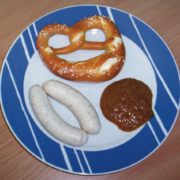
Cover picture:  © Weisswurst – Thomas S. Pubblic domain


Are you getting intrigued by the German language or wish to refine your vocabulary? Then take a look at the German courses that Berlino Schule organizes! 


5 tips to improve your German

Whether for work, for study reasons or because you are planning on moving to Germany, learning German is a life experience on its own. Few courageous people pursue the learning of the language for mere delight. Although seemingly impossible at first, these 5 advices can be of great help (if coupled with good will and determination).

1.Don’t expect to be perfect

The first encounters with compound words, not to mention the peculiar gender allocation, can be absolutely demoralizing. But more than deciding to learn all of the new vocabularies by heart, and shyly wait for years of courses before attempting to mumble a few sentences, the advice is to throw yourself with no shame nor fear. True for every language, this is particularly pertinent to German.

2. Read your favorite books in German

To read a text, whether a book, short story, poem or what not in German can be of great help to learn new expressions that we wouldn’t have otherwise been able to learn. For beginners even children’s’ books can help to find confidence with the language. Even more, a bilingual edition of the text could be more helpful for others. If instead you want to throw yourself in a fully German translation, don’t get discouraged if having to run to the dictionary often.

3. Listen to songs and watch movies in German

If you still don’t know German bands or singers, the time has come to route around Youtube. The lyrics of a song as we all know are easier to learn and allow us to expand our vocabulary. Regarding movies, as for books it would be advised to start by watching those that we already familiar with. We already talked about 5 useful TV series that can help to enhance our knowledge of the language. If the sounds might sound incomprehensible at first, don’t give up, with a good dose of determination you will start to understand bits and pieces and trust us, it will be a great satisfaction.

4. Watch tutorials on Youtube

On Youtube there are several video-courses on pronunciation and grammar tips. Even following videos on topics that interest us can help us develop a specific lexicon and enhance our interest. It doesn’t matter whether they are ‘serious’ videos or not, the important thing is to be motivated by curiosity and not only be a sense of duty.

5. Get out of your shell and make friends!

Although it might be hard at first, it is very important to seek for German people with whom you can converse, overcoming the initial obstacle of embarrassment and the lack of appropriate terms for the occasion. Alcohol in these contexts is known to help dissolve and lose many inhibitions, but everything must start with the willpower and the desire to open up their own horizons, to confront and integrate into the new environment in which you want to live.l

Another option out of the list that we feel is advising you, fundamental to learning the basics of grammar and to melting in the conversation, is attending a German course. If your choice falls on this option (obviously in addition to the others), you can write to info@berlinoschule.com, Berlin’s Berlin Magazine German School. You will be provided with all the information to enroll yourself in a course with qualified teachers and an international environment to start practicing this beautiful language directly on the field!


Photo: CC BY SA 2.0  Pexels

5 tiny German words that once learned will make you feel integrated

By now we all know it, whether through our German class or in our everyday encounter with native speakers, German is a tricky language to master. One of the reasons is surely its very, very extensive vocabulary. Yet not all of the words are as long as a sentence, some are very small and although seemingly insignificant at first they are actually the indicator of your proficiency in German. We are talking about those small words that once heard will make you long to learn and use in a conversation, and that will make you feel very satisfied when you’ll say them at the right moment.

  1. Doch

It is a conjugation that has a similar meaning to “aber” (but, yet) and can be used as a reinforcer to many sentences. As a single word ,however, it indicates a positive answer to a negative question. i.e. “Didn’t you go the movies yesterday?” … “Doch!”

  1. Genau

One of the first German words we usually learn and it means “exact, exactly”. Germans commonly use it to show that they are attentive to what their interlocutor in saying. Being one of the easiest and simple words, it is very common for people approaching the language that they’ll hear themselves use it and abuse it in any given context.

  1. Achso

This is an exclamation that Germans used to affirm (to great surpise) that they have finally understood what wasn’t evident before. In English the equivalent would be something like “Ooooh! Now i get it!”. i.e. “Isn’t Tim the collegeau you fought with? Achso!”. When you’ll start, it will be very hard to quit.

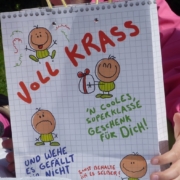
  1. Krass

It is an adjective that means “extreme” in the colloquial jargon of the Deutsch youth. It sort of took the place of the former cool and geil (strong) to convey something, ha!, a bit more extreme. Krass may be a night at the Berghein as much as a visit to a concentration camp. Learning how to use it is indispensable to demonstrate one’s linguistic proficiency when facing a native speaker. The risk? Everything that happened to you “Es war richtig krass!” (was really extreme!).

  1. Spontan

Germans are notorious for the pleasure they take out of planning. At times, though, they also enjoy being spontaneous, or, spontan. “Do you know what you’ll be doing this weekend?” … “I don’t know, I’ll be spontan!”


Cover photo: “Voll Krass” © Oliver Ponsold – CC BY SA 2.0

5 reasons why learning German is really difficult, and 5 reasons why it’s not

Learning German can daunting, fun and frustrating all at once. It is a test of patience and will, but it many cases it is not as difficult as it seems.

For this reason we have put together a balanced list of 5 reasons by which learning German can be really hard, and 5 reasons by which it isn’t that much.

Five reasons why learning German is hard…

1. Because you can say the same thing in about 500 different ways

German has a very rich lexicon. This is partly due to its incredible ability to create new terms through Wortbildung, literally, the building of words. As a sort of creative exercise, different words and nouns can be joined with one or more suffixes. Furthermore the French cultural domination of the 18th century spoiled the German language and influenced the expression of certain concepts from the time. When then Romanticism and its underlying nationalist ideology spread throughout Europe in the 19th century, certain linguists quite literally invented 100% German words to convey those same expressions (some examples include: division= Aufteilung, definition= Bestimmung…).
The result? Several things in German can be said with two completely different words that actually have the same meaning. The choice of the word will then depend on the context and stylistic criteria. Unfortunately, this richness in choice applies also to whole sentences and expressions.
Thus even if you have been studying German for 10 years and know of 5 different ways to ask “how are you?”, be sure that a native speaker will come to you one day and employ that 6th way that you couldn’t even begin to imagine it existed.

2. Because the spoken language is terribly different from the written one

Yes, this is probably the most interesting, not to say terribly frustrating, aspect of German: no matter how well you know ALL the possible grammatical rules, the gender of thousand of nouns, the sentence structure etc… most likely the you won’t be able to understand one thing from your first conversations with a German, in particular in informal situations. The spoken language has in fact a name for it’s own, the so called Umgangssprache (vehicular language). Its lexicon has even been assembled in dictionaries, and holds the peculiarity of being transversal to dialects.

What characterizes the spoken language is that array of small words that have absolutely no meaning on their own and that Germans use to give a tone to the sentence (a bit like hand gestures for Italians) such as mal, schon, halt, doch… The use of these words will immediately separate a native speakers from who, regardless of how fluent they may be, learned German as a second language. There is then the tendency to ask „Wo kommst du her?“ and „Wo gehst du hin?“ as opposed to the common „Woher kommst du?“ and „Wohin gehst du?“. To our delight, Germans also like to liven up the language with particular expressions and to the universally known “Wie geht’s?” they will probably prefer a „Wie läuft’s?“ or a „Wie ist es?“…

3. Because there are three genders for nouns and with the exception of a few rules, the choice is absolutely random

This is possibly the greatest shock when starting to learn German: to find out that not only there are three different genders (masculine, feminine and neutral), and only few, vague rules (words that end in -ung are all feminine, those ending in -er are usually masculine), but most importantly, that the gender is not always dependent on the word structure, but on some completely random and unexplainable criteria. More than trying to find a logical reason behind the fact that a girl, for instance, is neutral (das Mädchen), the advice is to just accept it and move on. The same applies for plural.
The result is that unlike other languages, where it is pretty much enough to learn a word and move on, in German you’ll have to simultaneously learn it’s gender and it’s plural form. A mental violence, basically.

4. Because certain sounds are really hard to pronounce

Some have made it. This story takes the contours of a legend because certain sounds in German are really, really hard to pronounce. Some have a difficult time with the ch (not to be confused with the sch!) of which there are actually two different versions: the one found after vowels as a, o, u (Dach, Buch, Loch, in phonetic x) and the one found after the interior vowels i, e, ä, ü, ö (ich, Brecht, lächeln, Löcher, Bücher in phonetic ç). If you never noticed don’t worry, it’s normal, Germans themselves probably don’t even realize. One other fascinating sound is the guttural r, the one that departs from that unknown angle of the throat and that completely changes the sound of words like Brot.

5. Because we can’t accept that some verbs can be separated and that a piece of that verb has to be placed at the end of a sentence

Yes, when looking on the dictionary you’ll find a “full” word with a certain meaning, such as ausgehen = to go out, but in everyday sentences that same word will be split in two and the suffix will go at the end. Why? Who knows. Episodes in which you’ll find yourself translating a sentence and happily think to have understood what verb it is, just to find out that you actually missed a “piece” of it, will be very recurrent. And your brain will trip every time you’ll try to converse and have to think of that small element.

Photo: “Schnecken Schlecken” © Andreas: https://www.flickr.com/photos/124330160/ – CC BY SA 2.0

…and 5 reasons for which it isn’t that hard after all

1.It’s a very logical language

It’s true, German has several grammatical rules, but few exceptions. Once you learn the rule you will unlikely have unpleasant surprises.

2. Because there are few pronunciation rules

Except for the difficulty of the sounds aforementioned, one can’t say that German has tough pronunciation rules. Unlike English, for instance, where every word is pronounced in its own way or French, where to rules are so severe and dictations are done even in the most progressed course levels. In German the only sounds that change are certain diphthongs (such eu= oi and ei=ai) and the v which is read as f. For the rest, pretty much all the words are pronounced as they are written. And this is surely something worth mentioning…

3. Because nouns are recognized due to the capital letter

Even if you never studied this language, surely you may have noticed in for instance instruction manuals that several words in German are written with a capital letter. Those are nouns: common or abstract these may be, in German they always have a capital letter. This way of doing resides to the times of Luther and it has been contested for long yet never abandoned: Germans are too convinced of the enhanced readability of a text.

4. Because German has rules to which one can abide to, whereas in English the grammar is more ‘flexible’, so to say

Although English is one of the most learned and used languages globally, the English grammar remains a mystery to much of the native and foreign speakers alike. To this day English has no academy  (unlike French’s Académie française or the Spanish’s Real Academia Española), and debates on verb tenses are very much alive. With German it’s easier, you have the rules and you ought to respect them. They might not always ‘make sense’, but at a certain point the the inner struggle fades.

5. Because you don’t have the gerund and the duration form

In English the dilemma on whether to utilize the gerund or not (i.e. “What do you do”? vs “What are you doing?”) is unresolved. The absence of such in German simplifies our life, not to mention that the (in)famous duration form is nonexistent. So, if you’ve been eating for the past hour you will simply say “Ich esse seit einer Stunde“. Simple and concise.

—-
If you are starting to get intrigued by the German language, take a look at the German courses that Berlino Schule organizes.

The essential guide to your first German conversation: 10 sentences to present yourself

When entering a German course, as much as in everyday life in Germany, the first questions you will find yourself to answer are always the ones about yourself.

To avoid finding yourself without words, or struggling to hold the first conversation with native speakers, we have put together ten useful sentences to help you present yourself both in formal and informal contexts:

1. Do you speak German/English?

Sprichst du Deutsch/ Englisch? (informal)
Sprechen Sie Deutsch/ Englisch? (formal)
You can also use the verb können to ask informally “Kannst du Deutsch/ Englisch (sprechen)?”

Answer: I am very sorry, I don’t speak German / Just a bit

Es tut mir leid, ich spreche kein Deutsch / ich kann kein Deutsch sprechen.
Nur ein bißchen.

2. What is your name?

Wie heißt du? (informal)
Wie heißen Sie? (formal)
Was ist dein/Ihr Name? (informal/formal)
N.B. you can also ask for the Vorname to indicate the first name, or Nachname if you are interested in knowing the surname.

Answer: My name is…

Ich heiße… Mein Name ist…

3. It’s a pleasure to meet you!

Es freut mich dich / Sie kennenzulernen (informal / formal)
Schön/ Nett, Sie Kennenzulernen!
Or, more simple expressions include:
Sehr angenehm; Sehr erfreut; Freut mich.

4. Where do you come from?

Woher kommst du / kommen Sie? (informal/ formal)

Answer: I come from… I am… (nationality)

Ich komme aus… Ich bin… (eg. italiener)
Aus welcher Stadt kommst du / kommen Sie? (informal / formal)

5. Where do you live?

Wo wohnst du / wohnen Sie? (informal / formal)

Answer: I live in Berlin

Ich wohne in Berlin.

6. How long have you been in Germany for?

Wie lange bist du/sind Sie schon in Deutschland? (informal/ formal)

Answer: For two years

Seit zwei Jahren.

7. How old are you?

Wie alt bist du / sind Sie? (informal / formal)

Answer: I am 26 years old

Ich bin 26 Jahre alt.

8. What is your profession?

Was bist du/ sind Sie von Beruf? (informal / formal)
Was machst du/machen Sie beruflich? (informal / formal)
Was ist dein/Ihr Beruf? (informal / formal)

Answer: I am a… I do…

Ich bin… Ich mache…

9. Do you enjoy Berlin?

Wie gefällt dir/Ihnen Berlin? (informal / formal)

Answer: I really enjoy it! / I don’t like it.

Berlin gefällt mir sehr. / Es gefällt mir nicht.

10. I have to go now. See you soon!

Ich muss gehen. Wir sehen uns bald!
Bis dann / gleich!
or, as a more formal alternative, Auf Wiedersehen!


Photo:How to Earn Customer Loyalty By Focusing on Customer Experience © Joe The Goat Farmer CC BY SA 2.0

Those foods and dishes that in Germany change name, region by region

Have you studied German, or wish to do so,  and think to have reached the finish line with a B2 or C1 level? Think again. Although your efforts will surely pay off, it will be enough to talk with a native speaker to realize the difference between the language you studied on books, and the spoken one.

One of the first things that you will become aware of when conversing with native speakers is the strong regional dimension of the German language. In Germany there are several terms used to describe the same thing: these vary on the linguistic register on the one hand, and on the region (Bundesland) and its dialect on the other. Some regional terms derive in fact from French, whose influence is very much present also in several German words. Other regionalisms are instead heirs to antique dialects, for instance the German spoken in the south-western regions, today’s Baden-Württemberg, confining Switzerland and Alsace, have a lot of local expressions that are incomprehensible for Germans from other regions. The terms used are thus reflective of the German region of origin. The newspaper Spiegel Online published a study with an interactive map through which it is possible to locate the origins of 24 German regional expressions.

Bread

Even the purchase of a simple white-flour bread, Brötchen in everyday German, may become a complicated matter if one is not aware of the term in use in the region in question. Who lives in Friburg in Brisgovia (Baden-Württemberg) calls it Weckle. Imagine someone from Freiburg walking into a Bäckerei in Berlin asking for a Weckle. The most likely reply would be Wat denn? Eine Schrippe meenen See? (What? Would you mean a Schrippe? in berlin-german). From south-west to north-east something as simple as a white-flour bread has in fact different terms,  Weckle or  Schrippe. Going north, at about 300km from Berlin, the same contested, white-flour bread will be referred to in a different way: in Hamburg you will have to order a Rundstück.
The situation is further complicated if one wishes to refer to a sandwich: officially in German it would be a Butterbrot, but in Freiburg in Brisgovia it would be a Vesperbrot, in Berlin a Stulle and in Hamburg a Schnitte. To further complicate the matter, concurring to the word employed the gender will change.

Potatoe

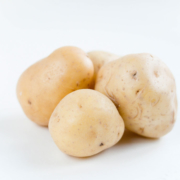
A trip at the supermarket will be enough to find out that there are different words used to refer to potatoes, commonly known as Kartoffel. The german Kartoffel derives from the Italian word tartufo (truffle). Potatoes in fact arrived in Germany from Italy passing through Switzerland. Having however similar shapes, and being both two tubers, potatoes and truffles were initially confused : that is how Kartoffel spread around Germany to refer to potatoes.
The term Erdapfel has instead different roots and indicates “a fruit from the soil” (Erde= land, Apfel= apple). The origins of Erdapfel can be traced to the French language, which similarly refer to pommes de terre (apples from the soil). This word is employed more commonly in the south of Germany, in Austria and Switzerland. The denomination Grundbirne (or Grumbeere, Grumbire, Gromper) derives instead from the similarity of potatoes with a tuber that arrived in Germany in the same period, the topinambur: when referring to potatoes, it is commonly employed in Renania-Palatinato in the regional dialects.

Krapfen and omelette

In standard German, by Krapfen it is meant a particular austro-german dessert. If however you are in Freiburg and wish to order it, you will have to call it Berliner. On the other hand in Berlin you will have to ask for a Pfannkuchen. The same Pfannkuchen in Freiburg would instead mean an omelette, which in Berlin is instead called Eierkuchen. So to avoid unpleasant surprises, it would be thus advised to study the local jargon! Or, to be safe, you could order a nice, universally known in Germany, Schnitzel (escalope).

Jelly meat and tripe

Sülze or Sulz is a cold dish, usually prepared with boiled meats and vegetables, finely cut in small cubes and incorporated with jelly, also known as aspic (Aspik in german). The term Sülze derives from an antique term used to define brine. However in south-western Germany, more precisely in the Baden region, you would have to specify what you mean if you don’t want to risk to find yourself facing a smoking place of tripe. The dish derived from a bovine’s stomach is in fact called Sulz in this region, whereas in the rest of Germany it is commonly known as Kutteln (in Saxony it has a different name: Piepen).


Cover photo: Kartoffeln / Potatoes © Marco Verch CC BY 2.0


Wish to perfect your knowledge of German? Then take a look at the courses that Berlino Schule organizes in the heart of Berlin by clicking here!

November German courses @ Berlino Schule


Learning German might be very discouraging and daunting at first due to its complicated grammar and very strict rules. Having a good teacher and being in the right learning environment is fundamental, and for this reason you should trust the right people and means: after the success of its Summer School, Berlino Schule opens the season with a wide offer of language courses lead by professional and qualified teachers with years of experience. The courses take place in small classes with a maximum of 10 students and in a positive and stimulating environment fit for all of those who want to learn German in a sympathetic approach.
At the end of the course you will receive a certificate of participation.

The School offers courses at various levels and at different paces:

Intensive courses

A1.1 (German for beginners): this intensive course for beginners will start on the 7th of November, and will take place 4 days per week (Tuesday to Friday, 8.45-11.15) through 3 teaching units (45 minutes each). It will last until the 1st of December.
This course has been thought for those who wish to properly acquire the basics of the German language through the help of professional teachers. The cost of the whole course is of €192 (only €4 per hour!)

A1.2: this intensive course for beginners will start on the 7th of November and will take place 4 days per week (Tuesday to Friday, 11.40-14.10) through 3 teaching units (45 minutes each). It will last until the 1st of December.
The cost of the whole course is of €192 (only €4 per hour!)

A2.1: this intensive course for beginners will start on the 7th of November and will take place 4 days per week (Tuesday to Friday, 8.45-11.15), through 3 teaching units (45 minutes each). It will last until the 1st of December.
The cost of the whole course is of €192 (only €4 per hour!)

B1.1: this intensive course for beginners will start on the 7th of November and will take place 4 days per week (Tuesday to Friday, 8.45-11.15), through 3 teaching units (45 minutes each). It will last until the 1st of December.
The cost of the whole course is of €192 (only €4 per hour!)

Evening courses

A1.1: this evening course for beginners will start on the 7th of November and will take place 2 days per week (Tuesday and Thursday, 19.15-21.40), through 3 teaching units (45 minutes each). The course will last until the 11th of January. The cost of the whole course is of €240.

A1.2: this evening course for beginners will start on the 6th of November and will take place 2 days per week (Monday and Wednesday, 19.15-21.40), through 3 teaching units (45 minutes each). The course will last until the 10th of January. The cost of the whole course is of €240.

A2.2: this evening course for beginners will start on the 7th of November and will take place 2 days per week (Tuesday and Thursday, 19.15-21.40), through 3 teaching units (45 minutes each). The course will last until the 11th of January. The cost of the whole course is of €240.
B2.1: this evening course for beginners will start on the 6th of November and will take place 2 days per week (Monday and Wednesday, 19.15-21.40), through 3 teaching units (45 minutes each). The course will last until the 10th of January. The cost of the whole course is of €240.


Prices & Registration

In addition to the cost of the course a €20 registration fee will be required. This will be a one-off fee that lasts the whole year. Registration to the course is allowed also once the course has began.

Location

The courses will take place at the headquarters of Berlino Schule & Berlino Magazine in Gryphiusstr. 23. Our school is located in Friedrichshain, one of the most charming, lively and safe quarters of Berlin. Walking distance from the School is the East Side Gallery, the longest remnant of the Berlin Wall and one of the best known landmarks of Berlin.

Course Calendar

Along with the intensive and evening courses, Berlino Schule also gives you the opportunity to take part in conversation classes. For any further info visit our website at BERLINOSCHULE or send us an email at info@berlinoschule.com