
Business German advanced online – only 132 €

⚠️IMPORTANT: this course is currently not part of our standard offer.

However, feel free to email us at info@berlinoschule.com to inquire about private classes or to receive updates on future course schedules!


Do you work in a company with German customers? You own a company and would like to expand into the German market? Are you a trader or a manager and want to increase sales and turnover? Then you must know Business German. Here is Berlino Schule’s online offer.

The advanced Business German course is tailored to employees or employers, traders, vendors, suppliers or managers who want to learn how to write a good e-mail in German, how to communicate correctly with the German customer or how to promote their product or service in order to increase sales and turnover. The minimum level required to attend this course is the B1.1.

Berlino Schule, well known for its Google (4.9/5) and Facebook (5/5) high ratings and positive reviews, is giving you the chance to learn comfortably from your couch.

You have a good idea but you cannot negotiate better, you would like to get a discount but you are not convincing when expressing yourself in German. How would you say: “I can only give you a 10% discount”, or “unfortunately we have to reject your proposal”. In this course, you will learn all the key phrases you need in following fields:

  • complaint
  • delay in delivery
  • request
  • order
  • offer
  • late payment
  • the promotional letter
  • money transactions (the bank, credit information, the stock exchange)

What you will learn in the course Business German advanced

How to…

  • negotiate
  • promote a product 
  • present a project
  • read an order
  • draw up an offer
  • write an email with the right courtesy formulas
  • explain the shipping conditions of the goods
  • explain the payment methods

The structure of the Business German advanced course

Each lesson (1 ½ hours) is divided into 4 parts: listening, reading comprehension, writing, and speaking. You will deepen all four skills by reading technical texts (such as credit notes, promotional emails, advertisements, orders, offers, shipping notes). For each text we will examine the main expressions, idioms, words used and recurring grammatical structures. Moreover you will then test yourself in the breakout rooms, where you will be divided into pairs or small groups and you will try to promote a product, sell it, ask for a discount, trying to use all the expressions and words learned in class. This is a comprehensive and highly interactive course. 

How to reserve a spot for the course

You can reserve your spot by writing an email to info@berlinoschule.com. 

Not only Business German!

Are you interested in a more general German course? Take a look at our offer of intensive courses in the morning, afternoon or evening and reserve your spot by writing an email to info@berlinoschule.com. 

Make the best out of your free time at home and learn or improve your German with one of the best language schools in Berlin. Berlino Schule, well known for its Google (4.9/5) and Facebook (5/5) high ratings and positive reviews, this month is giving you the chance to learn comfortably from your couch. Since the very beginning, the school has been working with proper classes based in Berlin and on Skype, helping hundreds of people to make their first steps into the German working scene. But German isn’t useful only abroad. Even in your own country, learning German can give a kick to your personal and professional life.

At a low price of €232 + 20 € (registration fee will be charged once, when you first enroll at Berlino Schule), you will have the chance to follow a 48 hrs course and a semi-language level (by semi-language level we mean A1.1, A1.2, A2.1 and so on). Berlino Schule offers also onsite classes in its school in Berlin (Gryphiusstr. 23). In case you are interested to the onsite classes click here. 

Educational leave in Germany (Bildungsurlaub): you study and the employer keeps paying you

If you work and live in Germany, you will have heard for sure about Bildungsurlaub. Do you know that you can take some time off for your professional training?

Bildungsurlaub is a quite unsual word. It means “educational holiday”, or rather “educational leave”: that is, you can take some time off to attend specific courses for your professional growth: yoga, foreign languages, political seminars, whatever suits your needs … and the employer keeps paying you! So, you do not need to take your holiday days to start studying a new langauge: you can basically have both a Bildungsurlaub and your vacation days.

In Germany, the professional and the political training is a right

The term “holiday” has a huge variaty of meanings: you can relax on the beach, go hiking or learn something. In this latter case, there is no longer need to use your vacation days. Instead, you can apply for a Bildungsurlaub. Have you ever dreamt about a study trip in Barcelona? Have you ever wished to attend a Spanish course but never had time to do it? With the German Bildungsurlaub, everything you have always dreamt of is possible.

The Bildungsurlaub is a great chance for your professional growth, but it is also a good way to reduce stress. That is why, more and more companies are investing in specific courses for their employees. A happy employee will always be more assertive and able to connect with their colleagues in a collaborative way. 

Who can apply for the Bildungsurlaub?

  • Employees (part-time and full-time)
  • Those engaged in dual vocational training (or Ausbildung)
  • Freelancers
  • Home workers

Special rules apply to civil servants.

Who pays for the Bildungsurlaub?

It is the employee that pays for their Bildungsurlaub, not the employer. Although you should spend some money on it, it is definitely a chance you should not miss: you can take some days off without deducting them from your vacation days, and you will be given the chance to take part in highly formative experiences (and the employer keeps paying you!).
Prerequisite: if you want to sign up for professional courses (berufliche Weiterbildung), they should be consistent with your tasks and duties in the company.

Where can I find Bildungsurlaub courses?

You can find thousands of Bildungsurlaub courses on Bildungsurlauber and here.

Applying for a Bildungsurlaub step by step

  • Once you have chosen your preferred training offer, you will have to ask your employer for a Freistellung (or leave permit). This must be done at least 6 weeks before the course beginning. What does Freistellung mean? It means that for max. 10 days, you are entitled to take part in an educational experience while continuing to be paid as if you were going to work.
  • You will then have to request a certificate of enrollment (Anmeldungsbescheinigung für die Teilnahme an der Bildungsveranstaltung) and the document certifying the recognition of the course as a Bildungsurlaub by the Berliner Senate (Anerkennungsbescheid der Senatsverwaltung für Integration, Arbeit und Soziales). This can be done at the school in which you are going to attend your course.
  • After getting the aforemetioned papers, your employer can give the consent, or refuse to give it.
  • After the course, you will get a certificate of attendance which you can show your employer.

For more information about your right to a Bildungsurlaub, take a look here.

Educational leave in Germany - Bildungsurlaub

Educational leave in Germany – Bildungsurlaub


Not only Bildungsurlaub!

Are you interested in a more general German course? Take a look at our offer of intensive courses in the morning, afternoon or evening and reserve your spot by writing an email at info@berlinoschule.com. 

Make the best out of your free time at home and learn or improve your German with one of the best language schools in Berlin!

Photo: PixabayCCOStartupStockPhotos


The German Perfekt (perfect tense)

What is the Perfekt and how do we build it? Here we try to sum up everything you need to know about this tense.

The Perfekt, just like the Präteritum, is used to talk about something that happened in the past. In fact, the Perfekt and the Präteritum are often used interchangeably. You could say “Gestern habe ich ein Buch gekauft” or “Gestern kaufte ich ein Buch”. 
The meaning is always the same: “Yesterday I bought a book“.

However, Germans mainly use the Perfekt in everyday oral language, whereas in the written and formal language they prefer the Präteritum.

How to build the Perfekt

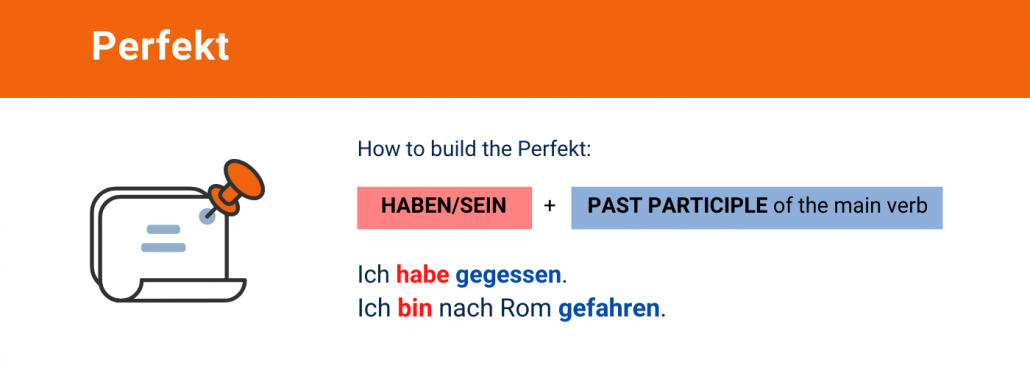
The perfect tense (Perfekt) is formed by an auxiliary verb and a past participle (Partizip II). The auxiliary verb can either be “haben” or “sein”, depending on the main verb, and it must be conjugated in the present tense (Präsens) according to the subject. Remember to put the past participle at the end of the sentence.

Ich habe eine E-Mail geschrieben. – I wrote an e-mail.
Sie ist nach Paris geflogen. – She flew to Paris.

Perfekt_rule


Past participle: weak, strong and mixed verbs

Weak verbs (schwache Verben)

Weak (regular) verbs build the Partizip II with the prefix GE and the suffix T. These should be added to the verb’s stem. For instance:

SAGEN – GESAGT
KAUFEN – GEKAUFT
LERNEN – GELERNT

If the stem ends in -T or -D we should add an E between the stem and the suffix T:

ARBEITEN – GEARBEITET
WARTEN – GEWARTET
REDEN – GEREDET

If the verb ends in -IEREN we do not use the prefix GE:

TELEFONIEREN – TELEFONIERT
FUNKTIONIEREN – FUNKTIONIERT


Strong verbs (starke Verben)

Moving on to strong verbs, their past participle does not follow a general rule. They add the prefix GE and they end in EN, but the stem often changes. For this reason, it is important to learn these verbs’ past participle by heart. A few examples:

FAHREN – GEFAHREN
GEHEN – GEGANGEN
BLEIBEN – GEBLIEBEN
HELFEN – GEHOLFEN
TRINKEN – GETRUNKEN


Mixed verbs (gemischte Verben)

Mixed verbs add the same prefix and suffix as regular verbs, but they change their stem:

BRINGEN – GEBRACHT
DENKEN – GEDACHT
WISSEN – GEWUSST
KENNEN – GEKANNT


Certain rules apply to both weak and strong verbs. For instance, when it comes to separable verbs, GE has to be put between the prefix and the root.

AUFRÄUMEN – AUFGERÄUMT (weak verb)
MITNEHMEN – MITGENOMMEN (strong verb)
EINSTEIGEN – EINGESTIEGEN (strong verb)

If the verb is non-separable (meaning that the verb has a prefix that never gets separated from it), we do not put GE:
VERSUCHEN – VERSUCHT (weak verb)
BESUCHEN – BESUCHT (weak verb)
UNTERNEHMEN – UNTERGENOMMEN (strong verb)


“Haben” or “sein”? Which auxiliary verb should we use?

In most cases, the Perfekt is built with “haben”. Nevertheless, verbs that indicate movement build the Perfekt with “sein”.

Ich bin nach Paris gefahren. – I went to Paris.
Er ist nach Hause gelaufen. – He walked home.
Wir sind zur Party gekommen. – We came to the party.

The same verbs can be used with “haben” when they have a direct object (Ich habe ein Auto gefahren – I drove my car), as well as when the focus is on the activity and not on the movement itself (Er hat eine Stunde gelaufen – He walked for an hour).


All reflexive verbs have “haben” as auxiliary verb.

Sie hat sich angezogen. – She got dressed.
Wir haben uns verirrt. – We got lost.


In addition, we should consider the verb’s transitivity. Transitive verbs (with direct object) build the perfect tense with “haben”, whereas intransitive verbs usually build it with “sein”.

Ich habe einen Apfel gegessen. – I ate an apple.
Ich bin geblieben. – I stayed.
Was ist passiert? – What happened?

Please note that the same verb can be used both as a transitive and as an intransitive verb.

Das Glas ist gebrochen. – The glass broke.
Ich habe das Glas gebrochen. – I broke the glass.


Was hast du gestern gemacht?

If you want to practice, try to list all the things you did yesterday. We gave you some examples.

  • Ich bin aufgestanden. – I got up.
  • Ich habe Brot mit Honig gegessen. – I ate bread with honey.


Looking for a German course?

Have a look at our website! Berlino Schule offers German courses with qualified teachers at a very convenient price. Feel free to contact us at info@berlinoschule.com in case you need any information.

Our contacts

Gryphiusstraße 23, 10245 Berlin-Friedrichshain
+49 030 36465765
info@berlinoschule.com
Facebook page
Instagram profile


Perfekt_modal verbs

The German Perfekt and modal verbs: gesagt or sagen?

Building the German Perfekt with modal verbs: the double infinitive

I had to say my name”…

Would you know how to translate this sentence into German? If the answer is no, you may want to keep reading this article. Sure, you can use the Präteritum and say “Ich wollte meinen Namen sagen”, but what if you want to use the Perfekt? In the following paragraphs, we will teach you how to conjugate modal verbs in the perfect tense. You will see, it is easier than you think!


A step back: the Perfekt

The perfect tense (Perfekt) is used to speak about an event that took place in the past. This tense is formed by combining an auxiliary verb and a past participle (Partizip II). The auxiliary verb can either be “haben” or “sein”, depending on the main verb, and it must be conjugated according to the subject.

Sie hat gegessen. – She ate.
Er ist nach London gefahren. – He went to London.


The Perfekt and modal verbs

Modal verbs can also be conjugated in the perfect tense. If the modal verb is used alone, we build the Perfekt with the auxiliary „haben” and the past participle of the modal verb, just like we have just seen. Again, the auxiliary has to be conjugated to agree with the subject.

Ich habe ein Glas Wasser gewollt. – I wanted a glass of water.
Sie hat Deutschland gemocht. – She liked Germany.

However, when there is no full verb in the sentence, we generally use the Präteritum of the modal verb.

Ich wollte ein Glas Wasser. – I wanted a glass of water.
Sie mochte Deutschland. – She liked Germany.

More often than not, a modal is used with another verb. In order to build the perfect tense, we use a specific structure called the double infinitive. Here is an example:

Ich habe nach Berlin fahren wollen. – I wanted to go to Berlin.


The Double Infinitive

Let’s go back to the sentence we were talking about in the first place.
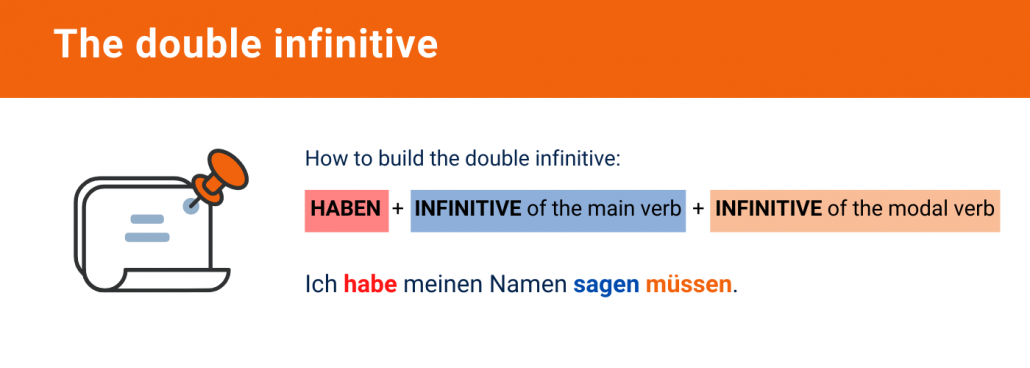
Ich habe meinen Namen sagen müssen. – I had to say my name.

To conjugate modal verbs in the Perfekt, we still need the auxiliary “haben” (conjugated in accordance to the subject). The difference here is made by the two infinitives at the end of sentence. That is why we call this “double infinitive”. In particular, we should put the infinitive form of the main verb first and then the infinitive form of the modal verb.

Remember to always put the two infinitives at the end. If there are some complements, these should be put between the auxiliary and the two infinitives or at the beginning of the sentence.

Ich habe meiner Mutter beim Hausputz helfen müssen. – I had to help my mother clean the house.
Gestern habe ich meiner Mutter beim Hausputz helfen müssen. – Yesterday I had to help my mother clean the house.

double_infinitive_rule

Let’s practice

Was hast du gestern machen müssen? – What did you have to do yesterday?
Und was hast du gestern machen wollen? – What did you want to do yesterday?
Try to answer these two questions using the double infinitive. You can make more than one sentence for each answer.

Examples:
Ich habe gestern lernen müssen. – Yesterday I had to study.
Ich habe gestern lesen wollen. – Yesterday I wanted to read.


Learn German with Berlino Schule

Learning German doesn’t have to painful. Berlino Schule’s highly qualified teachers will teach you everything you need to know in a simple way. Our school is rated 4.9/5 on Google and its average reviwe on Facebook is 5/5. If you want to know more about us, have a look at our website. For any information, you can send as an email at info@berlinoschule.com.

Our contacts

Gryphiusstraße 23, 10245 Berlin-Friedrichshain
+49 030 36465765
info@berlinoschule.com
Facebook page
Instagram profile

Konjunktiv II

The German Subjunctive II (Konjunktiv II) explained

Here is a guide to when and how to use the Konjunktiv II in German. Learn and start practicing with us.

Are you struggling to build sentences using the German Subjunktiv II? Don’t worry, we have got you covered. In this article we will teach you when to use the Konjunktiv II and how to build it.

First of all, you must remember that the Konjunktiv II is used to talk about hypothetical situations. It allows us to talk about our dreams and desires, but also to make suggestions or to soften a request.

Konjunktiv II rule

Here are a few examples:

Hätte ich Zeit, würde ich viele Bücher lesen. – If I had time, I would read a lot of books.
• Wir könnten ins Kino gehen – We could go to the cinema. (suggestion)
• Ich hätte gern ein Stück Torte – I would like a piece of cake. (kind request)

There are two ways to build the Konjunktiv II

1. If we want to build the Konjunktiv II of a verb, we start with the stem used in the Präteritum. Then we add the same endings used for the Präteritum.

Ich kaufte (Präteritum) –>  ich kaufte – du kauftest – er kaufte – wir kauften – ihr kauftet – sie kauften (Konjunktiv II)

As you may notice, the Konjunktiv II of weak verbs (like kaufen or sagen) ends up looking exactly like their Präteritum form. Strong verbs and mixed verbs, instead, add an Umlaut (where possible) to their Präteritum stem.

geben – gab – ich gäbe
bringen – brachte – ich brächte

However, for the majority of verbs, we usually don’t build the Konjuktiv II in this way. It is preferable to follow another structure instead (see point 2 below).


2. We can also build the Konjunktiv II with the auxiliary “werden”. We just need to learn its subjunctive form:

Ich würde
Du würdest
Er würde
Wir würden
Ihr würdet
Sie würden

Here is how most verbs build the Konjunktiv II:
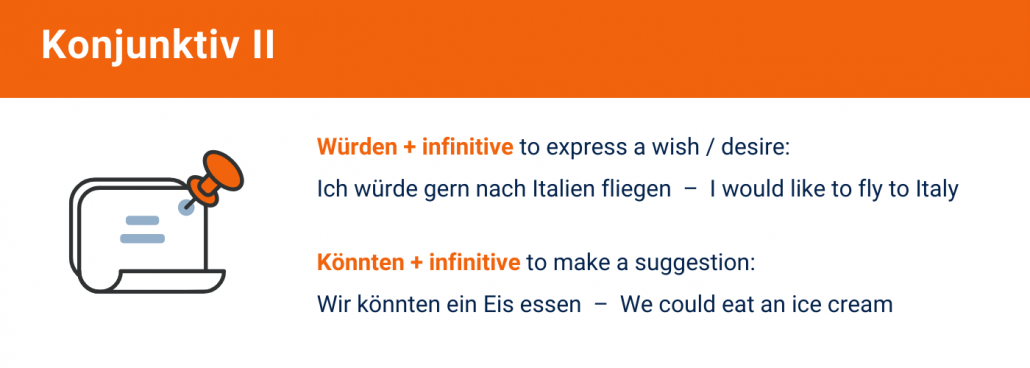
Würden + infinitive

Ich würde gern eine Pizza essen. – I would like to eat a pizza
Sarah würde gern einen Hund adoptieren. – Sarah would like to adopt a dog.
Was würdest machen, wenn du viel Geld hättest? – What would you do if you had a lot of money?


Some verbs don’t build the Konjunktiv II with “würden”

When it comes to auxiliary (haben and sein) and modal verbs, we should use the first form. That means that in these cases we do not use “würde”. Please note that “wollen” and “sollen” do not want the Umlaut.

Ich hätte
• Ich wäre
• Ich möchte – ich könnte – ich dürfte – ich müsste – ich wollte – ich sollte

There are also a few irregular verbs, whose Konjunktiv II is often built starting from the Präteritum. These are:

• gehen – ging –> ich ginge
• kommen – kam –> ich käme
• wissen – wusste –> ich wüsste
• finden – fande –> ich fände
• lassen – ließ –> ich ließe
• schlafen – schlief –> ich schliefe


Konjunktiv II in the past

So far so good… now let’s move on the past form. There is nothing to be scared of, if you remember how to build the Perfekt. Instead of using the present form of the auxiliaries haben and sein, you just have to switch to their subjunctive form. For instance:

Perfekt: Ich habe mein Zimmer aufgeräumt. – I tidied up my room.
Konjunkitv II – past tense: Ich hätte mein Zimmer aufgeräumt, (wenn ich Zeit gehabt hätte). – I would have tidied up my room, (if I had had time).

Perfekt: Ich bin nach Paris geflogen. – I flew to Paris.
Konjunkitv II – past tense: Ich wäre nach Paris geflogen. – I would have flown to Paris.


Things get a little more complicated when you have to build the past tense of the Konjunktiv II with modals. In this case, you should use the following structure:

Hätten + infinitive + infinitive of the modal verb (hätten + double infinitive)

Ich hätte das Abendessen kochen müssen. – I should have cooked dinner.
Peter hätte nach Österreich fahren können. – Peter could have travelled to Austria.


It is important to remember that we should always use the auxiliary “haben”, even if we would have used “sein” for the Perfekt (see: “er ist gefahren” vs “er hätte fahren können”).


Let’s practice!

Was würdest du machen, wenn du reich wärst? – What would you do if you were rich?

Ich würde einen Urlaub auf den Malediven machen – I would go on vacation to the Maldives
Ich würde ein Haus am Meer kaufen – I would buy a house by the see

Und du? Was würdest du machen? And you? What would you do?
Try to list at least three things that you would do if you were rich.


Was würdest du tun, wenn du keine Angst hättest? – What would you do if you had no fear?

Ich würde in eine neue Stadt umziehen. – I would move to a new city.
Ich würde Bungee Jumping ausprobieren. – I would try bungee jumping.
Ich würde vor Publikum singen – I would sing in front of an audience.

Now try to list three things you would do if you had no fear.


Would you like to keep learning German?

Berlino Schule offers German courses from A1 to C1. Our certified teachers are waiting for you!

Berlino Schule has the best quality-price ratio (check the reviews online, 4.9/5 on Google and Facebook). Click here to access the calendar and reserve your place by simply sending an email to info@berlinoschule.com.

Our contacts

Gryphiusstraße 23, 10245 Berlin-Friedrichshain

+49 030 36465765

info@berlinoschule.com

Facebook page

Instagram profile

The winners of the photocontest #quantoèbellaberlino

Today the photocontest #quantoèbellaberlino ended and we have selected the three winners! The prizes were a German course at Berlino Schule, a dinner for two at MedEATerranean Trip and an artisan bier tasting with apetizers at Birra.

Summer School

The Summer School courses are super-intensive German courses that last two weeks and take place from July to September. They consist of 5 -hour*  daily classes, from Monday to Friday, for a total amount of 50 hours*. The atmosphere is very friendly and the teachers certified and experienced. Here the information about the next courses.

The first winner has the possibility to take a course for free and complete a semi-level in just two weeks!

The contest

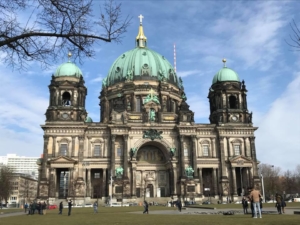
The photo contest aimed to represent Berlin and highlight its beauty. Of course there were the Berliner Dom, the Siegessaule and the Brandeburger Tor.

The final ranking

We have selected the final winners taking into consideration the likes each photo had on 2nd of July at 12:00.

The first place: with 1117 likes the winner is Elisa Pozzi with her photo Back to the 90ies.

The second place: with 613 likes Lorenzo Sartori wins the second prize with his picture Berlino è più forte della realtà.

The third place: with 176 likes Maria Stefania Atzori wins the third prize with her photo Duomo di Berlino.

Here the photo album of the contest #quantoèbellaberlino on Berlino Magazine’s Facebook page to enjoy the pictures of the German capital.

To claim the prizes send an email to info@berlinoschule.com