Tag Archive for: berlino schule

Not only in Germany! 10 German words which are commonly used also in other languages

The German language: not as foreign as we think

It’s a fact, that learning German is not easy at all. Anyone who wants to learn this language must deal with a complex grammar, the existence of three genres (masculine, feminine and neutral), the length of the words and the basic unfamiliarity of each sound. In order to make the learning of German easier, we may remember that many words from German are actually used globally as an important part of the common language. For example, look at the following terms: Müsli, Strüdel, Kitsch, Bunker or Realpolitik. As we can see, the Teutonic influence is quite obvious in many different fields: food, culture, military or politics. Now, let’s focus on the most commonly used worldwide German words:

Hinterland

Literally meaning “the land behind”, is a common word in English, French, Spanish and Italian. Hinterland stands for “backcountry” or “a remote area of a country away from the city centre influenced by economics, society and culture”. For example, in Italy we often hear of “hinterland milanese”.

Schadenfreude

Common word used in English to express “joy” or “satisfaction” for one’s misfortunes. The Italian translation is “gioia maligna”.

Kindergarten

Literally “children’s garden”, it can be used in English as a synonym of “nursery school”.

Zeitgeist

This is a worldwide term used to express “the spirit of the time”. The expression comes from philosophy to indicate the ideal climate, culture and spirit (considered as characteristic of an era).

Wanderlust

Literally meaning “desire of walking” is commonly used in English in order to express “the craving for travel”.

Leitmotiv

Literally “guiding reason” is a global word which indicates “a motif or constant aspect of a literary or musical work” but also of “activities, manifestations and different behaviours”. Apart from the musical field, it has also become common to others.

Wunderkind

In English “wonder/prodigious child”.

Doppelgänger

It means in English “body double/alter ego”.

Spiel

Literally “play or game”. This term is used in English with the meaning of “eulogistic speech” or “long and boring speech”.

Delicatessen

Commonly shortened in Deli in English, Delicatessen means “culinary specialities shop”. The German word Delikatesse, which stands for “deliciousness”, derives from délicatesse, or “delicacy”.

Documentary Filmmaking, in Berlin the new course by the Daring House Film Production

Create your own short documentary in six classes!

Berlino Magazine and Berlino Schule in collaboration with Daring House Documentary School are hosting a basic module about Documentary filmmaking. On 2th October there will be a free presentation of our Filmmaking course. The workshop will then continue with classes on Tuesdays, from 20:00 till 21:30 for 5 weeks at Daring House Studio, Auguststraße 88, 10117, Berlin-Mitte.

Course objectives

Now more then ever digital technology allows people to express their own vision of reality – and this is what our course is about. In a set of structured meetings, attendees will learn how to find, shoot and edit a story, in close interaction with an enthusiastic group of people. The films will then be presented at a short documentary film festival held in Berlin, with an awards ceremony and attendance certificate for everybody.

The course will let you create your film FOR REAL. During classes, you will use your own camera and have a look at videos of nice and established filmmakers.

The module is for those who want to try their hands at filmmaking as a hobby or are considering making it a profession; for journalists wanting to expand their audiovisual skills; for film-enthusiasts wanting to learn the process of filmmaking.

The course will be held in English and the instructor also speaks fluent German, Italian and Spanish.

Program

Class 1 – Filmmaking 101 – 2.10.2018, 20:00-21:30 – FREE TRIAL LESSON.

– What is a documentary? Break free from the accepted rules and create your “own” story.
– Tragedies, illnesses, catastrophes and sad people. Why you should try (also) to tell happy documentary stories.
– How are documentary stories told? The different styles of storytelling: real life, interviews, with or without a host, mockumentary.
– Any story is a good story if well told. The approach to find a story and the importance of personal feelings in storytelling.
– What do I need to shoot: camera/smartphone, pc.
– Writing or not writing? How far should filmmakers go with their script.

Class 2 – Working with your story – 09.10.2018 – 20:00-21:30

– How to tell if a story is worth being told
– Red flags 1: stories you should avoid.
– Red flags 2: people you should avoid.
– How too approach a person to shoot a documentary.
– Shooting: how to make your story appear natural.
– The “fly on the wall”: how to disappear behind the camera.
– Emphatic listening and the key to good interviews.

Class 3 – Hands on your camera – 16.10.2018 – 20:00-21:30

– Basics of smartphone cinematography. How to hold a smartphone camera and how to operate it.
– Basics of camera cinematography avoiding zoom and multi-focal lenses.
– Audio: why a good sound is more important that good images.
– Shooting with natural light.
– Creating a shooting frame: concepts of shooting aesthetics.
– Project pitching! Suggesting stories and creating shooting teams.

Class 4 – Editing – 30.10.2018 – 20:00-21:30

– Basics of editing: please start telling your story from second 1.
– Why knowing editing is important to shoot good images.
– Editing with free programs.
– Editing with professional programs.
– Documentary dramaturgy: please don’t bore your audience.
– Creating emotions with editing. How to play an audience like an instrument.
– “Kill your darlings”: why your personal shooting experience is different than the story you are telling.
– Working with music: from Dogma to La La Land.

Class 5 – Rough-cut workshop – 06.11.2018 – 20:00-21:30

– Review of the projects and tips to make them even better.
– Closing a project: why “films projects are never finished, but abandoned”.
– Basics of subtitling.

Class 6 – How to call yourself a filmmaker and closing the final cut – 11.12.2018 – 20:00-21:30

– Review of the projects and tips to make them even better.
– Dreaming about a filmmaker career? Here’s what you need to know.
– Don’t trust the festival. A quick guide to festival submissions.
– “We are all dead” and other depressing statements by filmmakers and artists in general.
– The documentary film industry. How to have fun making film art and live happily.
– Preview of the following modules.

Price

The course costs 175€.

The teacher

Stefano Casertano is an award-winning filmmaker living in Berlin since 2006, CEO of the production company Daring House. His last film as director “People of Love and Rage” won the Eindhoven FIlm Festival and the Special Mention of the Jury at the Rome Independent Film Festival. As a producer, his animated short “The Ballad of the Homeless” screened at the Cannes Film Festival, won a Nastro d’Argento, was a candidate at the David di Donatello and won the LA Short Fest, being shortlisted for the Academy Awards. Stefano is currently producing his fourth documentary “Eighteen Penalties” about the story of the football matches between Italy and Germany produced by Istituto Luce and Lichtblick Film, with the support of the Italian Ministry of Culture and the German Film Funding Institute. Stefano also serves as producer and filmmaker for video productions for media outlets such as El Paìs, Sky, La7, RBB and Rai. Before embarking in his film career, Stefano completed an MBA in Media and Communication at Columbia University in New York and a Ph.D. “Magna cum Laude” in International Politics at Potsdam University in Germany. He has been international correspondent for Linkiesta.it, Finanza & Mercati and Pagina99, and his articles have appeared on World Affairs, Project Syndicate and RealClearWorld.

Advanced modules to be scheduled:

– Documentary filmmaking advanced module

– Immerse yourself in a story and create a structured film plan. Basics of color and audio correction.

– Documentary filmmaking technical module

– How to shoot a video with a reflex camera

– Music videos – How to shoot a music band

Documentary Filmmaking Course

6 lessons from Tuesday 2nd of October. from 20:00 to 21:30

2nd October 2018: free trial lesson (20-21.30).

Facebook event

Lessons will be held at Daring House – Auguststraße 88, 10117, Berlin.

The course costs 175 €

INFO AND REGISTRATION

For info and registration send us an email at: info@berlinoschule.com with object: Filmmaking

Berlino Schule

A day of Free trial German classes at Berlino Schule

For anyone who is not sure about his/her level of German, and for those who wish to check out Berlino Schule’s teaching method, on the 6th September there will be a full day of free trial lessons at different times according to your level

For anyone who is looking for a great German school in Berlin, on the 6th September 2018 Berlino Schule will be hosting a full day of free trial lessons, of 35 min each to promote its German classes starting in September and introduce its teaching method.

Program of the Free trial classes (6th of September)
A1.1: 11.00 – 11.35
A1.2: 11.40 – 12.15
A2.1: 12.20 – 12.55
A2.2: 13.00 – 13.35
B1.1: 13.40 – 14.15

To reserve your spot send an email to: info@berlinoschule.com by specifying the level you are interested in.

Facebook event

Upcoming German courses at Berlino Schule
INTENSIVE COURSES:
Our intensive courses are made up of 3 teaching hours per day, 4 days a week. Total amount of hours: 48 hours.

A1.1 11th September – 5th October (Tue – Fri 8.45 – 11.15)
A1.2 11th September – 5th October (Tue – Fri 11.40 – 14.10)
A2.1 11th September – 5th October (Tue – Fri 8.45 – 11.15)
A2.2 From 11th September (Tue, Wed, Fri 14.30 – 18.00)
B1.1 11th September – 5th October (Tue – Fri 8.45 – 11.15)
B2.1 11th September – 5th October (Tue – Fri 8.45 – 11.15)

Price: 192 euro + 20 euro registration fee

EVENING COURSES:
Our evening courses take place twice a week for 8 weeks. Three hours per lesson.

A1.1 10th September – 31st October (Mon and Wed 19.15 – 21.40)
A1.2 10th September – 31st October (Mon and Wed 19.15 – 21.40)
A2.1 11th September – 31st October (Tue and Thu 19.15 – 21.40)
B1.1 10th September – 31st October (Mon and Wed 19.15 – 21.40)
B2.1 11th September – 31st October (Tue and Thu 19.15 – 21.40)

Price: 240 euro + 20 euro registration fee

Our teachers
The courses are held by teachers with certified experience in the language teaching field. At the end of the course a certificate of attendance will be released on demand.

Info and registration
Send an email to info@berlinoschule.com and we’ll reply with all the information you need. Check also our website to know more about Berlino Schule.

Mille Grazie! The Italian courses of Berlino Schule starting from September

Pizza, Ciao bella! Amore, capito, buongiorno, Spaghetti … would you rather learn the basics of one of the most beautiful languages in the world?

If you really want to speak this beautiful language as perfectly as Dante Alighieri, why don’t you attend the Italian language courses offered by Berlino Schule? From September you will get the opportunity to choose between Mille Grazie I (A1) and Mille Grazie II (A2).

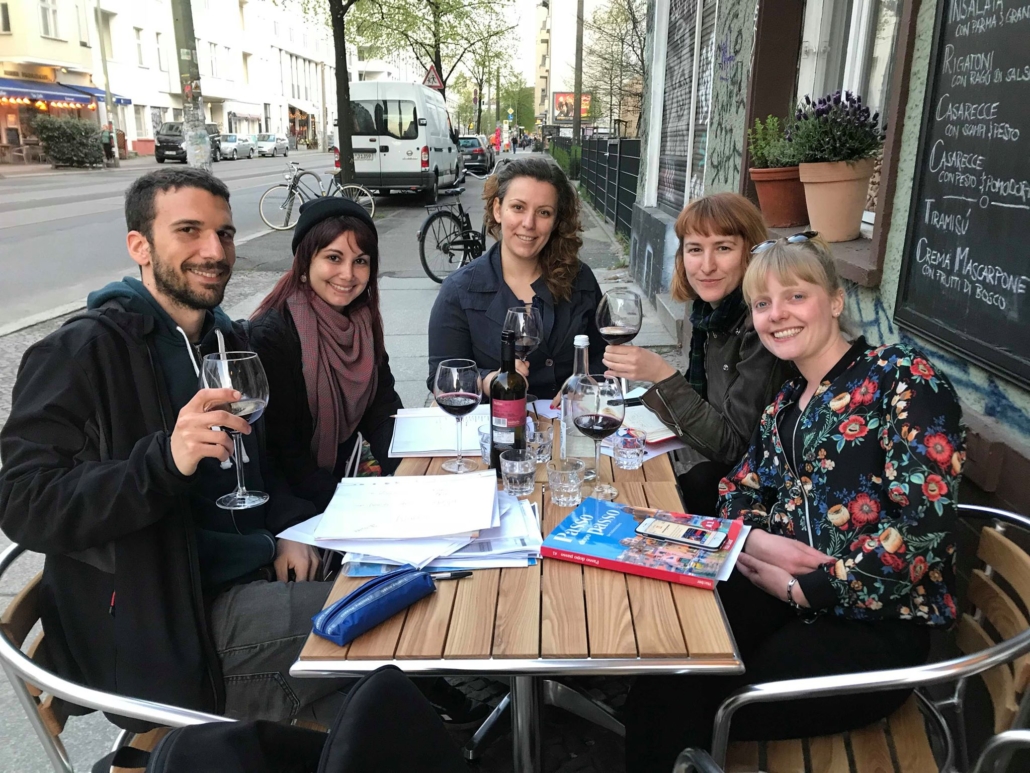
Italian classes in Berlin

Italian classes in Berlin

The teacher

Both courses will be held by Giuseppe R., extremely professional Italian teacher with the DITALS certification, a professional qualification offered by Unistrasi (Università per Stranieri di Siena).

OUR ITALIAN COURSES STARTING IN SEPTEMBER

Mille Grazie I – Italian language course A1

Mille Grazie I starts on 12th September. The whole course is composed by 16 classes of 3 units each for a total of 48 units.

Every Wednesday, from 19 to 21.30

Price: 240 €

Mille Grazie II – Italian language course A2

Mille Grazie II starts on 11th September. The whole course is composed by 19 classes of 2,5 units each for a total of 48 units.

Every Tuesday, from 19 to 21.00

Price: 240 €

Where: Berlino Schule – Gryphiusstr. 23 – 10245 Berlin

Info and registration

You can send us an email to: info@berlinoschule.com. Object: “Mille Grazie”.

Where

At Berlino Schule, Gryphiusstrasse 23 – 10245 Berlin (Friedrichshain, Ostkreuz/Samariterstrasse/Warschuaerstrasse metro station).

How to memorize 18 German words without getting a headache

German continues to be a source of inspiration in many ways. The fact that it is still a cryptic language for many is not a novelty.

Learning German is for many an impossible task due to, amongst other things, the many consonants placed close to each other and the rigid pronunciation of words. The structure of the sentences, the syntax, still puts the most talented Germans in crisis. The Germans themselves often admit that they do not know the meaning of a term and therefore use the famous Richard Porson’s saying that “life is too short to learn German.”

German words

To make the whole thing even more grotesque is the (in)famous German morphology with its endless composite words, one of which has even entered the Guinness Book of Records as the longest word in the world: Rechtsschutzversicherungsgesellschaften (companies that provide legal assistance). And if long words were not enough, then there are those that in a few syllables contain a myriad of different meanings, impossible to synthesize in English in one word. Here is a list of the most bizarre and astrus ones selected by the site Fluentu!


18. Ohrwurm= earworm [for instance when you hear a song on the radio and can’t get it out of your mind throughout the whole day]


17. Fernweh= longing for a distant and unknown place


16. Kummerspeck= literally, grief bacon, in context it is having an emotional belly [or the need to eat to console your belly following a disappointment]


15. Innerer Schweinehund= inner pig/dog [it is that very powerful animal that lives within us that we must overcome when we have to do unpleasant things, like paying taxes and going for a jog at 6am before work]


14. Fremdschämen= feeling shame for someone else


13. Torschlusspanik= panic of the closed door [it is commonly employed to address a woman whose biological clock is ticking]


12. Treppenwitz= staircase joke [it occurs when the right joke comes to your mind when it’s too late, as if you have a pleasant meeting on the stairs and you have no time to say the right thing]


11. Lebensmüde= life tiredness


10. Weltschmerz= pain of the world


9. Weichei= soft egg [N.B. never say that to a waiter in Germany, for the actual meaning of the term is to address someone that is cowardly and has “soft balls”]


8. Backpfeifengesicht= face you would like to slap


7. Erklärungsnot= need to explain [have you been punished and didn’t even have the time to realize it? Then claim your Erklärungsnot!]


6. Sitzfleisch= seat meat [a character trait, to have big shoulders. For the German collective imagination it is like having a sac of meat on your seat due to an excessive state of boredom]


5. Purzelbaum= tumble tree [Somersault! Roll on the floor as if you were a piece of tree trunk]


4. Dreikäsehoch= three, cheese, above [a term for children employed towards that kid in the class that is taller compared to others, as tall as three pieces of cheese on top of another]


3. Zungenbrecher= tongue twisters [read about hilarious German tongue twisteres here]


2. Schattenparker= shadow parker [are you trying to be smart and park your car in the shade to protect it from the heat? This term is not actually meant as a compliment, but more as an insult]


1. Kuddelmuddel= unstructured mess


If you read until here and now your head is fully of screws and you are thinking that the German language is like a witty mosaic, an unstructured mess, then this is the word that you need right now.


Do not be discouraged, German is a very charming language and with some commitment everyone can succeed in mastering it. And studying German is also a good way to overcome the sense of Lebensmuedigkeit and stop using google translate which, let’s say it, never gets it right. And additionally to be taken for a Schattenparker that doesn’t commit does not please anyone. In the end, there are surely other Weltschmerz that are worse than learning German. After a thousand Kummerspecken overcome thanks also to the strength that you have gained by experiencing the Torschlusspanik, you can go out with your German friends and also take their order when you go to the restaurant. And this time without any of them feeling Fremdschämen for you.

You can finally be totally proud of having overwhelmed your Innerer Schweinehund. It is the same feeling of when, as a child, you felt so powerful after succeeding in a new intent. When you felt that you stood out like a Dreikäsehoch. You have gone a long way and now you have your Sitzfleisch. After a thousand nights spent on a thousand absurd Zungenbrecher until they become actual Ohrwurm. You will not be considered a Weichei anymore, and surely this time you will be able to talk to your new neighbors without fear of falling into any Treppenwitz. Except if it’s your girlfriend, in that case you’d risk a proper Backpfeifengesicht. Be careful not to combine any Kuddelmuddel or to use your Erklärungsnot!

If after all this you still want to stay and do not experience any sea sickness or Fernweh, there is nothing left to say or do than return to your inner child and gain thousands of well earned Purzelbaum!

Cover photo: © Alexandre Normand CC BY SA 2.0


Want to learn German in a vibrant environment? Look no further and check out the German courses that Berlino Schule organizes by clicking here!

50 steps to become the perfect Berliner

Today we would like to talk about a very special book, How to be German (in 50 easy steps). It is an unpretentious manual whose intention is to transform the reader in a perfect teutonic mutant, with all the merits, tribulations and idiosyncrasies that derive from it. Supported by ironic illustrations for each step it is written in German and English.

The approach is utterly ironic and amusing, and the 50 steps to follow span from the Apfelsaftschorle to German bureaucracy, to the much-hated GEMA to living bio, the fines on public transport, all the way to the beloved Kartoffelsalat. It also talks about the sacredness of Tatort on Sunday evenings and the importance of greeting cards for any special occasion. A spiritual compilation that has cheered my first U-Bahn trips and most often ripped me off in laughter in the religious silence that reigns on wagons, stirring up the discreet curiosity of my taciturn traveling companions who, after having looked at the title in cover, understood the reason of so much hilarity and would often exchange a smile.

The author, Adam Fletcher, is a Cambridge blogger and marketing expert who has been in Berlin for some years now; on his official page he describes himself as “a writer, an amateur chocolate eater and a professional napper,” as well as author of three enjoyable volumes such as “A Picnic for Perverts” (2012), “The Hipster Guide” (2013) and “Denglish for Better Knowers” (2014). After the tragicomic closing of Neukölln’s Hipstery store, Adam continues to write his satirical pieces and sell his line of gadgets through e-commerce, narrowing the target and type of products that he and his partner smuggle under a single, exhaustive label: “things that make us laugh.” The kit of the perfect Berliner hipster is one of the most genius and hilarious finds I have ever found. Take a look at yourself, if you do not believe it.

15. «MAHLZEIT!»

German has the reputation of being a pragmatic and literal language. Both nouns – like the nipple, for example, that was renamed with the romantic Brustwarze (“wart on the chest”), and the too explicit Antibabypille – and some of its expressions, which sometimes seem to describe not a mood or a state of mind, but the mysterious mechanics of an invisible car: “Es mennuft” (“works”), “Es geht” (“goes”), “Es passt” (“its fits good, it adapts”) , “Alles in Ordnung” (“all in place”).

This can serve as an appetizer, intrepid Ausländers, but to become real Germans you must learn to use the most pragmatic and disconcerting greeting of all – “Mahlzeit!”, Translated with “have a good meal!” or more literally with “meal time”. I had just arrived in Germany and while I was sitting in the canteen for lunch, my colleagues walked by the door and said to me, “Mahlzeit! ». Mahlzeit? Mahlzeit? Lunch time? Well, no doubt! That I’m eating is obvious. Right now I am clearly and loudly swirling a potato salad. I’m chewing, don’t you see? I know it’s a bit early for lunch, but I admit I missed breakfast. Do not judge me, have pity, please!

Only then do you understand that it is not a question. It’s a redundant, clumsy disguised statement, like a kid playing and stealing clothes from its parents, a form of greeting. So, for the sake of integration, over time you will start using it too. At first, it will sound a little bit weird, but I assure you that after a while you will find it rather fun, especially since in many regions of Germany you can use it at any time of the day. You can call someone at 4 am when you know for sure that they are still sleeping and wish them “Mahlzeit!” Brilliant. Perhaps you are wondering why you can’t add the -zeit suffix to other activities to create new and original greetings. But German literacy begins and ends just when you start to grasp its meaning. Glove is Handschuh (“hand shoe”), but do not dream of calling the Kopfschuh hat (“head shoe”). Do you see someone drinking? You can not wish him “Trinkzeit!”. You neighbours are having sex and don’t even bother covering up the moans? It is not admissible to ring the bell and wish them a warm ‘Fickzeit!’

Only «Mahlzeit», understood?

(Adam Fletcher and Ingo Herze, How to be a German/ Wie man Deutscher wird, Verlag C.H.Beck oHG, München 2013, pp.23-24)


Want to learn German in a vibrant environment? Look no further and check out the German courses that Berlino Schule organizes by clicking here!


Berlino Schule Corsi di tedesco Corsi online di tedesco

Small vademecum to handle German without performance anxiety

Let’s start with a basic assumption, which to the ear of many will sound redundant: German is a difficult language. Fascinating, mysterious and that gives lots of satisfaction if handled with the same audacity and wonder of the first explorer of an ancient Khmer temple. But notoriously, irremediably and damnly complicated. For their own admission, Germans often love to repeat amongst themselves “Deutsche Sprache, schwere Sprache” (“German language, difficult language”), alluding to the challenges and idiosyncrasies that one of the most spoken mother tongues of Europe poses. Not to a German speaker, ça va sans dire, that he will almost certainly have learned to spell “Uberraschung” even before the word “Mom”. The problem arises when a foreigner, with greater or lesser goodwill, approaches the arcane and often indecipherable complexity of this idiom – an idiom extremely logical, schematic and intuitive for some, too obscure and deterrent for others.

Perhaps this is due to the fact that German, like other Indo-European languages, has both fusional and agglutinative traits. Which are not strange food intolerances or incurable diseases, but large containers where languages are organized in lists and classified according to morphological phenomena that have led to the formation of words over time. The difficulty in learning German is that in some ways it is a language that tends to flex (the grammatical cases and the declination of nouns and adjectives are a clear example) and at times tends to condense (see words of disproportionate length, formed by the addition of prefixes and suffixes to a lexical or verbal root). If we add to this the unclear identification of the gender, the fact that the conjugated verb or the participle – hence the key of everything – are placed very often after a forest of complements and at the end of a kilometer long sentence, the presence of a hostile and multifunctional auxiliary as werden and not to mention the use of at least five different mechanisms for the formation of plural names… well, it is not surprise if the beginner’s reaction will be one of outmost panic.

Don’t despair, and most importantly don’t give up, if at the restaurant you will be facing three objects that can be associated to three different grammatical genders on the same table: der Löffel (the spoon, masculine), das Messer (the knife, neutral) and die Gabel (the fork, feminine). The first instinct will be probably be to want to throw the table in the air, scream at the waiter whilst emitting undignified sounds and run as far as possible from so much linguistic confusion. But it is not by running away that you will be able to solve the problem. If you really want to feel like the master of your own destiny and of your future communications in the teutonic land, you will simply need to change your approach to a language that is not that harsh after all. So no more feeling lost, aspiring Germanophones, and keep in mind that:

– There is no obstacle that constant studying can’t overcome

Studying, studying, studying. Whoever has arrived to Berlin, or in Germany at broad, with a linguistic repertoire limited to a guten Morgen and Dankeschön will better look for a school or a valid method to approach this language seriously. In Germany there is a classification of learning levels (based on the Common European Framework of Reference for Languages) starting from the A1, the basic step, and arriving at C2, the highest level, which presupposes an excellent mastery of the language. The achievement of each level implies the frequency of two intermediate modules: the A1 level, for example, is achieved with the frequency of A1.1 and A1.2. A constant study of the language implies that to the 100 hours of frontal lesson for each module, at least as many hours should be dedicated to an individual study, following the debatable advice of learning and memorizing at least 10 new words per day. If math is not an opinion then this brings us to the conclusion that to reach a discreet language level which can be considered the B1 it is necessary to dedicate at least 1.200 hours of sweat and tears. There is no other way, it is the only investment possible to achieve satisfactory results. A very popular but improbable motto says that life is too short to learn German. I am more inclined to believe that those who are convinced that they can go without studying German have a short life in Germany.

– The spelling and pronunciation of German can be quite intuitive

Unlike other languages like French, and apart from a few phonemes and diphthongs that can be easily memorized, German is read as it is written. And this makes it easier to pronounce it and spell it correctly. When the constructs will seem too difficult and the adjective declination will make you panic, you can always refresh your self-esteem on the basis of phonetic progress. It will be the first conquest in your climb over the legendary teutonic giant, and will also support you through dark times. Of course, these are also the first, tragic telephone conversations in German, a topic that deserves a post for its own.

– Verbal times have a much simpler use than Romance languages

In German it is absolutely normal to use the present time to express a future action, so that a phrase like “Tomorrow I will go to the theater” is a grammatically correct statement and also accepted in the written use. In addition, in the majority of Germany, but actually at the south of the so-called Weißwurstäquator (the imaginary equatorial of the white sausage marked well on the Danube path), 99% of speakers prefer the use of the Präteritum / remote past than the Perfekt / past, since it easier to memorize. Try to make a confrontation with the endless sequel of Italian, French, and Spanish verbal times, and then we can talk about it.

– There is an underlying logic and you can see it

All German nouns are written in uppercase: even Mark Twain, in his disheartening attack on the astrusive German language , was forced to admit that it was a good idea. In German there is a strict and stringent logic; once the verb prefixes are learned, at least in 60% of the occurrences, it will be incredibly easy to understand the meaning. When you will assemble genres and cases, be certain that you will almost certainly feel the concreteness and pragmatic nature of this language. Legend has it that the old (and rather unfair) stereotype of Germans who are devoid of any sense of humor arises precisely from the exaggerated precision of German language. But do you want to deny the dragging hilarity of a straightforward and unequivocal expression like “das kannst du deiner Oma erzählen” or “Go tell your grandmother?”. Germans do not need subtle hints: they go straight to the point.

-Playing with words and neologisms

The tendency to agglutinate that we aforementioned (which is also the primary cause of panic attacks registered on German soil, especially among foreign speakers, when confronted with innocuous words such as Elektrizitätswirtschaftsorganzingswirtschaftsorganisationsgesetz) can actually become a weapon to exploit to your benefit. Do not be overwhelmed by the number of letters! If you really want to apply an arithmetic approach to the language, divide the long word into its individual components, sum up their meanings until you get the overall one, subtract the anxiety and multiply the satisfaction of having understood without too much effort the sense of those forty-four letters. Not to mention that if your limited knowledge of German prevents you from completely expressing a concept, you will always be able to coin a new words without being treated as a crazy person but more as a great innovator and original language experimenter.

– Get germanized

The internet universe now offers the most complete and fun platforms that can help you integrate to your conventional and on-paper study of German some very efficient methodology. But above all it integrates a fundamental component: the entertainment. Amongst the various sites consulted during study hours and after scrolling the numerous tutorial or pseudo-educational proposals on YouTube, I’ve found and continue to find a lot of fun Get Germanized, the channel designed and created by Dominik Hannekum, present and active daily also on Facebook and on Twitter. Through a very direct and informal approach the channel becomes a sort of navigator that helps beginners to navigate among the difficulties of the basic German grammar. By deciphering the lexical curiosity of the slang, the most entertaining approaches that you may listen to in a club in Berlin, proverbs, untranslatable words, the small obsessions and thousands of other cultural nuances that are absent from the aseptic study of an idiom. It is absolutely advice to dispel with a smile the dreadful and unjustified fame of a labyrinthine language, that can prove to become incredibly fascinating.


This short account does not claim to be exhaustive or universal, but only aims to introduce you with a bit of more optimism to your descent into the Hochdeutsch. Each expedition might seem impossible at the beginning, and you are a small explorer setting off to discover a linguistic and mythological treasure. So arm yourself with courage, a good dose of initiative and remember that … “Mit Geduld schafft man alles,” with patience you win everything.


Nothing left to say than to wish you for a good trip.


And if you are living in Berlin and looking for a well taught German course, look no further can check out the classes offered at Berlino Schule here!
Bud Spencer, Di Caprio, Michael Fassbender: 15 celebrities that unexpectedly speak German 

It’s true, actresses, actors and singers have a talent when it comes to the recognition and reproduction of sound.

German however remains a language that few people, at least in the past generations, decided to learn unless it was for work reasons. What follows is a list (partly inspired from the one made by Smosh) of American, but not only, celebrities that can modestly speak German, as the videos demonstrate.

Bud Spencer

The actor from Naples was a real star in Germany, as so was his colleague Terrence Hill. His autobiography reached the vectors of sale a few years ago. All his movies were distributed in cinemas and in the ’70s it was common to find him on German TV to promote his movies. He studied German in school in Italy and never failed to demonstrate it, as this video shows.


Sandra Bullock

The Oscar winning actress with The Blind Side, and for a few years the most paid actress in the world, is the daughter of a German singing teacher, herself the daughter of a missile scientist that lived in Nuremberg. It was in Baveria that her father, the American John Bullock, at the time serving the American army, met her mother and began a love story lived through the States and Germany. Although she was born in Arlington, Sandra Bullock lived in Nuremberg until the age of 12.

Chris Pratt

The Guardians of the Galaxy start learned (well) German in school. The father, American, has German origins, but not only: as he himself admits in the past he nurtured a true passion for Goethe’s language.

Leonardo Di Caprio

On the one hand, as his surname discloses, he has Italian origins. On the other hand, from his mother’s side, German grandparents. It was his grandmother, from a small town close to Düsseldorf, that taught the Oscar winning actor that he uses at times to make his German audience smile.

Mark Strong

One of the greatest “supporting actors” of this century, the excellent Mark Strong has an Austrian mother, but not only. He studied law in Munich’s university for one year prior to dedicating himself completely to acting, his passion since youth.

Kirsten Dunst

The American actress holds to this day her German citizenship. The father was in fact a doctor from Hamburg that moved to the States and her mother (that has Swedish origins) worked for Lufthansa. German is thus a family affair for the Dunst family

Paul McCartney

McCartney learned German in school as a child. It became useful when the band, unknown at the time, made Hamburg its continental base, performing there any time they had the chance. The first time was in 1960 when, as reported here “Allan Williams, owner of a music cafè in Liverpool had to organize a tour in Germany for “Derry and the Seniors”, a Liverpool-based rock band. But things went wrong and Williams was forced to find a substitute band in a short amount of time. He asked The Beatles, whom no one at the time heard of, that immediately accepted”. Bild also talks about it here

Terrence Hill

Unlike Bud Spencer, Terrence Hill (aka Mario Girotti) speaks German both because he studied it and because his mother came from Dresden. It was there that, along with a chemist father working for the Schering, he moved when he was 4 in 1943, in the midst of the second world war. He lived there until 1945 with his grandparents in the close Lommatzsch, prior to returning to Venice, his father’s city.

Gene Simmons (Kiss)

The singer of the band Kiss was born in Israel (his real name is Chaim Witz). His mother, a Hungarian jew, lived through the time of concentration camps. He spoke German and taught it, and his son today speaks Hebrew, Hungarian, German and English

Vladimir Putin

From the man of KGB to Dresda, eastern Germany, both before and after the fall of the Wall, Putin could have not not known German….

Michael Fassbender

He was born in Germany, in Heidelberg to be precise, even though he always kept his Irish citizenship. In Bastards without Glory that language learned due to the origins of the father (a known German chef) allowed him to convince Tarantino to give him the role that served him as a trampoline for his career.

Kim Cattrall

The Sex and the City star, although having a well-established career in English speaking countries, in the 80s as she was married to Andre J.Lyson (they then divorced in 1989) lived in Frankfurt.

Karl Urban

The Lord of the Rings star (do you remember Éomer?) and of Star Trek, was born and raised in New Zeland, but his father is German and always spoke to him in his language.

Sarah Chalke

Anyone who watched Scrubs knows this very well: Sarah Chalke speaks very good German. It is the series that mostly insisted on her quality, building up different funny scenarios. Her grandparents from her mother’s side live in Peez, close to Rostock.

Donna Summer

The american singer that passed away in 2012 lived for long in Germany throughout the 70s as she became the protagonist of the theatre version of Hair. There she met Austrian Helmut Sommer with whom she had a child with. This is where here surname comes from (she was born Donna Gaines).


© PROGage Skidmore CC BY SA 2.0

—————-

Do you wish to make it one day on this list? Then take a look at the German courses that Berlino Schule organizes in Belrin here!

“The dative is the death of the genitive”, the book where Germans make fun of their own language

Is it possible to combine studying and careful attention to the proper use of the language whilst having fun?

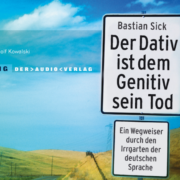
But above all: is it possible to do so with the German language, generally considered one of the most difficult to learn due to its lexicon and rigid grammar that recalls the  Latin one? The innovative German grammar booklet “Der Dativ ist dem Genitiv Sein Tod” (translated “The Dative is the death of the Genitive”), made up of 6 volumes published by Kiepenheuer & Witsch between 2004 to 2014, seems to have been able to do that perfectly, given that for the first time ever a language manual has managed to become an international bestseller with over 3 million copies sold.

Sebastian Sick, The dative is the death of the genitive

The author of this achievement is Bastian Sick, curator of the linguistic column Zwiebelfisch on Spiegel Online: the German term Zwiebelfish indicates those letter of a text that by mistake are reported in a different character compared to the others; Sick chose the term Zwiebelfisch as a title for his column as a metaphor of the German phenomenon of using words and expressions that would formally be incorrect. Journalist, entertainer, but especially a humanist specialized in history and romance philosophy, Sick began his career as a translator and interpreter: his passion for German language and grammar has allowed him to achieve a fine awareness of the language that is hard to find amongst professionals of the academic world and schooling staff. The title of Sick’s work “The dative is the death of the genitive” alludes to the grammatically incorrect replacing of the genitive with the dative in a lot of current German expressions. The same expression “Der Dativ ist dem Genitiv sein Tod” is grammatically incorrect, yet spread widely following the publication of the work. The 6 volume collection is a compilation of the articles published in Sick’s coloumn Zwiebelfisch.


The method

The case studies selected by Sebastian Sick aren’t tailored expressions, literary texts or lists of rules to learn by heart, but sentences that derive directly from conversations amongst native speakers, road signs, advertisements or newspapers. Sick deals with great humor certain grammatical, spelling and pronunciation cases that are common in modern day spoken and written German. Everyday life becomes the occasion through which even those whose first language is German have a chance to reflect and talk about  it with friends and acquaintances without having to resort to dusty toms stored in the library. At the same time Sick’s approach is also good for those who are new to the German language, but wish to know the nuances they often miss during frontal lessons. Sick’s work is one that aims to convey not only the rules for a good use of the language, but also the pragmatic, whose traditional study is often difficult to understand even within an academic environment. At a time where we are all coming to the terms with having the best results in the shortest amount of time, mistakes are demonized to the point of making us forget the universal truth that lies within the saying “one learns through mistakes”. Highlighting mistakes and analyzing them with the right lightness and irony, without falling into strict academic rigorousness, silencing the shame and fear of making another mistake, allowing you to better accommodate the corrections and learn the language effectively.

The opinion of the readers

Precisely due to its innovative features, “Der Dativ ist dem Genitiv sein Tod” hasn’t been welcomed warmly by everyone. Some appreciated Sick’s style and humor to the point of having integrated his manuals within the bibliography to prepare for German exams, others have instead condemned him for his method of analysis. Others have even spoken against it becoming an school text, as deemed not to be fit for students. As for any language manual there will never be a universally positive judgment, however one must recognize certain unique aspects of Sick’s work. In the first place he has a real talent in getting the reader’s attention on the topic, considering that it is not of the most approachable. In the second place is his focus on the modern day use of the language, which is ever more important to foreigners arriving to Germany right now. There will always be the fans of the “purist” language, that spend their time correcting the common use of new grammatically incorrect expressions, however given that every spoken language has a life of its own maybe it is time one accepts Sick’s lightness and irony: debating about mistakes, neologisms, of the most uncommon expressions can contribute in helping speakers to become more aware and conscious of the language’s mobility and variations.

In the meantime, if you wish to test your knowledge of the language, you can try to answer the following quiz available on Sebastian Sick’s private page!


Are you new to the language or have studied a bit of it and wish to perfect it? Take a look at the German courses that Berlino Schule organizes in Berlin!

10 really long German words that are impossible to pronounce without making mistakes

German is (in)famous for its long words.

Speaking properly in German gives a lot of satisfaction, but it is undoubtedly a hard language to learn for foreigners. This time we propose a list of ten of the hardest German words to pronounce without making mistakes. There aren’t many phonetic rules in German, but the fact that:

  1. the words can be very, very long (adjectives, nouns and conjugations at times are put together in the same word)
  2. there are several consonants at times following one another without even integrating vocals on which one can ‘rest’ upon

making the pronunciation of certain words almost impossible.

The following list of 10 words includes everyday expressions and also old-fashioned terms, which are however present in dictionaries. The meaning of some of these contributes to the understanding of the attention that Germans pose on the accuracy of the meaning of the words.

Anyways, the game is another: are you capable of pronouncing out loud all ten words without making mistakes?

10. Freundschaftsbeziehungen

Friendly relations

9. Kraftfahrzeughaftpflichtversicherung

Motor vehicle liability insurance

8. Bezirksschornsteinfegermeister

Regional chief of the chimney sweepers

7. Betäubungsmittelverschreibungsverordnung

Regulation for the prescription of an anesthetic

6. Rechtsschutzversicherungsgesellschaften

Insurance companies that offer legal protection

5. Streichholzschächtelchen

Small box of matches

4. Donaudampfschiffahrtsgesellschaftkapitän

Chief of the vapour expedition company on the Danube

3. Wachstumsbeschleunigungsgesetz

Growth acceleration action

2. Rindfleischetikettierungsüberwachungsaufgabenübertragungsgesetz

Beef labeling monitoring delegation Act

1. Sonntagnachmittagsfernsehlutschbonbon

Lollipop for a sunday afternoon spent in front of the TV


Cover photo: geralt / 14498 immagini, © CC0.

——————————-

Wish to perfect you German in a vibrant environment? Or is German starting to intrigue you? Then take a look at the German courses that Berlino Schule organizes in the heart of Berlin!

Tag Archive for: berlino schule